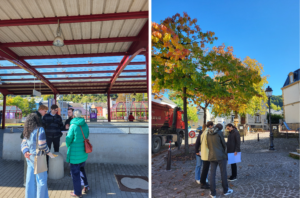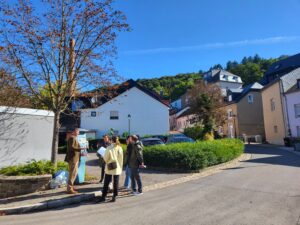


What if a municipality could test the impact of a new neighbourhood, a mobility measure or a climate adaptation strategy before it is built? What if planning scenarios could be visualised, compared and discussed in a shared digital environment? The Interreg North-West Europe project Twin4Resilience (T4R) explores these questions by supporting municipalities of different sizes in working with so‑called Local Digital Twins (LDTs). With the municipality of Schuttrange as one of eight pilot partners, Luxembourg is directly involved in examining what this approach can mean in everyday planning practice.
Digital Twins as decision-support tools
Local Digital Twins are digital 2D or 3D models of real places – such as a city or region – that bring together different types of spatial data in one shared environment. They make it possible to visualise a territory, explore how it functions and test planning options before decisions are taken. Instead of replacing formal planning instruments, LDTs support them by making connections more transparent – for example between land use, traffic patterns, energy use or environmental impacts.
Across Europe, local and regional authorities face increasingly interconnected challenges: climate adaptation, housing pressure, mobility transitions, land-use conflicts and resource efficiency. These issues are data-intensive and often cut across administrative silos. While digital twin technologies are becoming more accessible, their practical use remains uneven. Many municipalities are still clarifying what an LDT can realistically deliver, how it should be governed and maintained, and how it can be integrated into democratic decision-making processes.
Twin4Resilience addresses this gap. The project aims to strengthen the capacity of local and regional authorities to use Local Digital Twins in a resilient, inclusive and responsible way. Instead of developing new software, the project focuses on institutional capacity, governance questions and skills – for example clarifying roles and responsibilities for data management, defining standards for transparency and ethics, and training municipal staff to use and interpret digital twin outputs in daily planning practice.
A transnational framework for learning
Interreg North-West Europe, one of the EU’s transnational cooperation programmes. Interreg supports regions in working together across borders on shared territorial challenges. Within Twin4Resilience, 14 partners from six countries collaborate on advancing the use of LDTs in public planning.
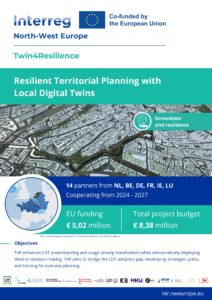
Project summary (source: Interreg North-West Europe – T4R: https://www.schuttrange.lu/media/0f5d762a-1a2a-4a37-8cce-64e64aa73667/poster-interreg-t4r.pdf)
The project is structured around four interconnected frameworks: technical design; governance; ethics, inclusion and democracy; and training and education. These frameworks guide joint reflection and implementation. The objectives are to improve understanding of the benefits and limits of LDTs, support their democratic and affordable integration into decision-making, and bridge the gap between cities already experimenting with digital twins and those at an earlier stage.
These objectives are implemented through eight pilot actions implemented by cities, regions and intermunicipal bodies across North-West Europe – including Utrecht, Amsterdam, Rennes Métropole, Dublin City Council, Brussels, Leiedal, the Flemish Environment Agency and Schuttrange. Each pilot develops and tests a concrete local use case under real planning conditions. The lessons learned feed into a Joint Strategy and Action Plan and into a collective training programme targeting around 300 participants, linking experimentation with structured capacity building.
Schuttrange: testing the approach in a small municipality
Schuttrange, located on the outskirts of Luxembourg City, has around 4,427 residents representing 91 nationalities and fewer than 50 municipal employees. The commune comprises five localities – Schuttrange, Munsbach, Uebersyren, Schrassig and Neuhaeusgen – and combines a village-like character with strong road and rail connections. Like many municipalities in Luxembourg, it faces pressures related to growth, infrastructure, mobility and resource management.
Within Twin4Resilience, Schuttrange pilots a Local Digital Twin that brings together data from multiple existing sources into a common database. Data is collected via different interfaces and connected to systems already in use, such as the municipal energy monitoring system and a 3D model of the territory. The commune deliberately develops small, interoperable programmes that can connect to commonly used systems (such as KNX, Smarty energy counters or LoRaWAN), keeping costs and complexity manageable and making the approach potentially transferable to other municipalities.
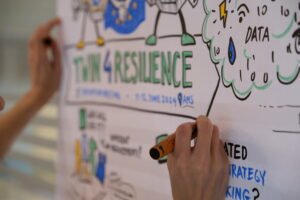
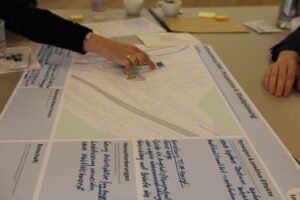
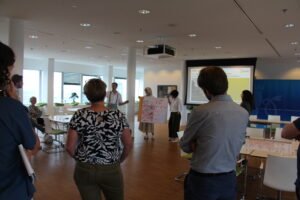
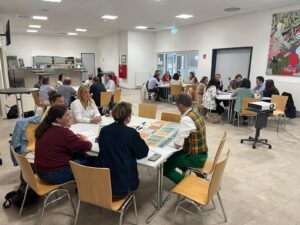
Discussion on the Open Digital Twin (source: Interreg NWE project T4R, blog post “Towards a Digital Twin Governance Approach”: https://t4r.nweurope.eu/blog/blog-posts-71/towards-a-digital-twin-governance-approach-1341?anim)
The pilot focuses on better understanding the territory and the municipal building stock by combining data that is currently stored in separate systems. The aim is to automate certain processes and enable more data-based decisions. Expected benefits include more efficient municipal operations and improved monitoring of issues related to climate, infrastructure and resource use, ultimately contributing to energy and water savings.
The project also places emphasis on digital literacy, cybersecurity and stakeholder engagement. This was visible during the consortium meeting hosted in Schuttrange in December 2025, when partners from across North-West Europe met to exchange experiences and review ongoing pilot work. Local stakeholders presented initial use cases of the Digital Twin, and workshops addressed stakeholder needs and training approaches. The meeting illustrated how the Schuttrange pilot is embedded in continuous peer exchange and joint learning rather than developed in isolation.
Outlook
For Luxembourg, Twin4Resilience adds a concrete municipal perspective to ongoing debates on digital planning instruments. The work in Schuttrange shows how transnational cooperation under an EU programme can support smaller municipalities in testing and embedding Local Digital Twins within everyday administrative practice and governance structures.
As the project progresses through its pilots, joint strategy development and training activities, it will become clearer how these experiences translate into longer-term planning routines and inter-municipal exchange. The insights gained in Schuttrange – on data organisation, governance responsibilities and capacity needs – may inform broader discussions on how digital tools can be integrated more systematically into territorial planning in Luxembourg.
These experiences will also be shared at the upcoming CIPU Online Colloque in February and March 2026, where a representative from Schuttrange contributed to the second session (02. March) and a delegate from the Province of Leiedal will present the regional perspective in the final session (26.March).
Contact & further information
Project website: https://t4r.nweurope.eu/
Muncipality of Schuttrange: https://www.schuttrange.lu/developpement-durable/twin4resilience
Project blog on activities: https://t4r.nweurope.eu/blog/blog-posts-71
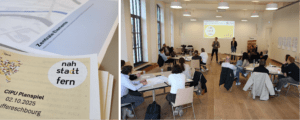
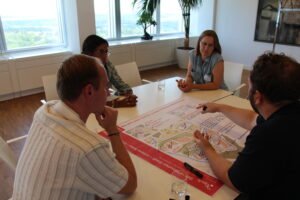
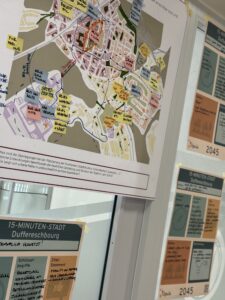
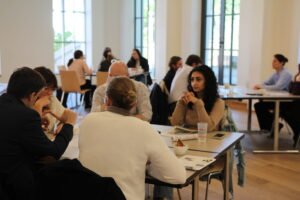 Group discussion in the public participation process about the culture and leisure district of Duffereschbourg 2045 (source: CIPU)