Blog CIPU

The first eco-village in the Greater Region: BENU village in Esch-sur-Alzette, South of Luxembourg

>

Cities are hot spots of ecological disruption due to excessive consumption of natural resources and high pollution by inhabitants. At the same time, cities are also creative spaces where existing models and rules are challenged, and alternatives are developed and tested.

‘Eco-districts’ and ‘eco-villages’ are new approaches and concepts that are being tested in urban areas. With principles such as ‘zero-waste’ and the circular economy becoming increasingly popular, these initiatives currently experience a renaissance with great interest of the public, decision-makers and urban planners.

Rationale for action

Circular economy has become a trend topic in Luxemburg during recent years. Decision-makers, urban planners and building research investigate new techniques and materials to render urban construction following the ‘zero-waste’ principle and the principle of circular economy.

At the same time, the demand for products that are produced in an ecologically and socially viable way increases. Alternatives to our established consumption model become more mainstream and promote alternatives to the linear economy of today. Many grassroot initiatives benefit from this recent trend towards a more circular approach in construction and an increasing demand for alternative products. BENU village has committed itself to this idea and in doing so has become the first eco-village of the Greater Region.
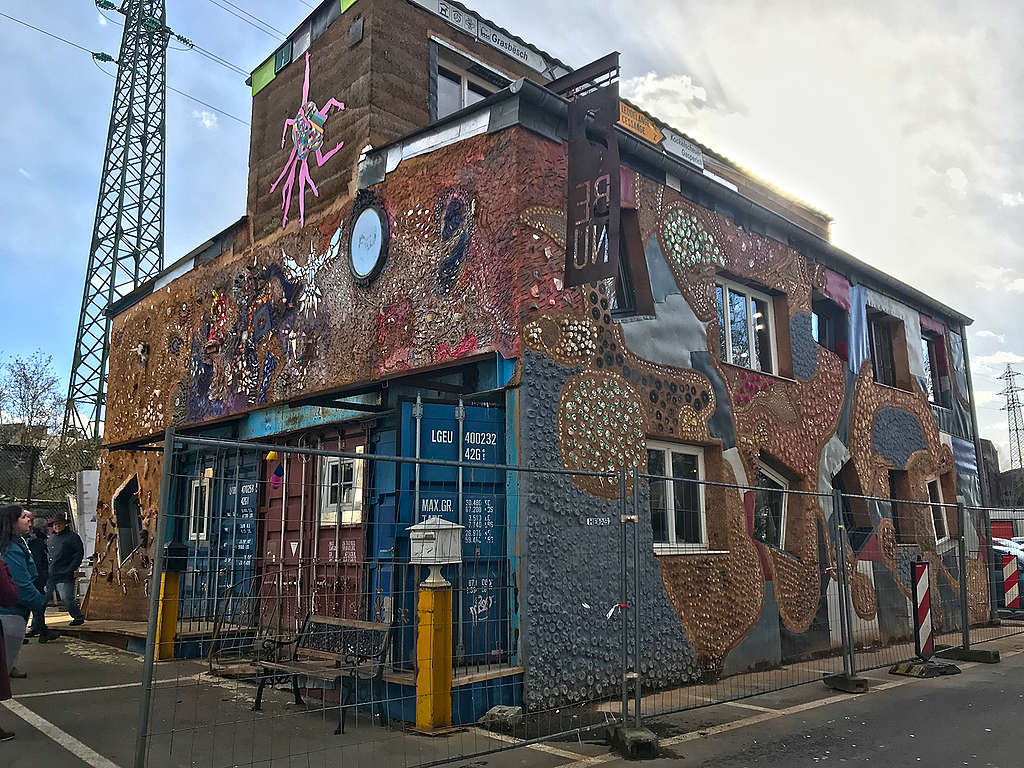
Outside view on BENU village. Source: https://www.greenpeace.org/luxembourg/fr/actualites/4321/benu-village-esch-un-ecovillage-au-luxembourg/

Objective

BENU village, (neologism for “Be New”) is the name of a grassroot movement in Esch-sur-Alzette. Its objective is to showcase that alternative models to the mainstream way of building and consuming are possible, and so in Luxembourg.

In this regard, the construction of the first eco-village of the Greater Region follows circular economy principles and also the economic activities are committed towards recycling, reusing and upcycling.

Time frame

The idea to create the BENU village first came up in 2015. A private person had the idea, which soon came to realisation. In 2017, the construction of BENU village started and the first building was finalised at the end of 2019.  
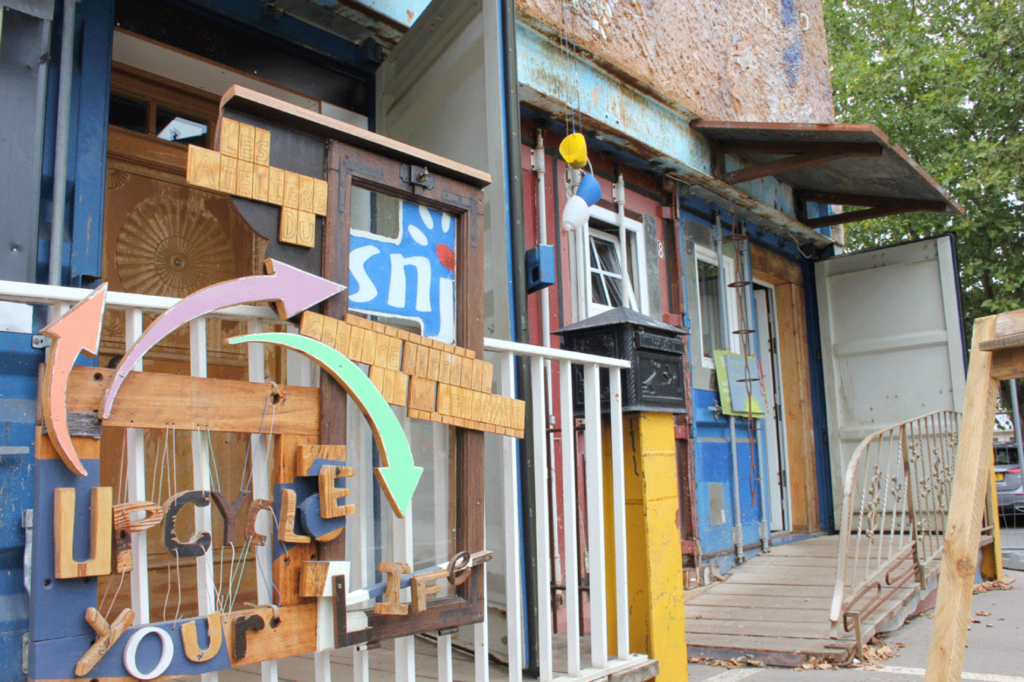
View of the entrance of BENU village. Source: https://www.moien.lu/benu-village-franz-fayot/

Key players

To formalise the idea and to increase its visibility towards the public, the city and the state, an association was founded to endorse the implementation of the eco-village: “BENU Village Esch ASBL”. The association is financially supported by the municipality and the state.

During the realisation, other state players became interested in the project. Businesses and state services use the premises of BENU village. For example, the national integration service for young adults organises learning programmes in BENU village.

Implementation steps and processes

All building materials used for the construction of BENU village derived from either re-use or recycling. Since the start of the construction in 2017, many volunteers have supported the building of the first house, which was finalised at the end of 2019. In addition to the volunteers, the project was supported by local craftsmen and other businesses that provided knowledge and materials.

In the building process of the village, considerable attention was devoted to the use of recycled materials. During the construction, only the screws were purchased new, the remaining materials, for example the windows, the wood used for framing, the insulation and the exterior shell of the houses, were entirely recycled from waste.

Soon after the first building was realised, shops moved in. The founder and initiator of BENU village opened “BENU Couture”, a tailor shop that produces clothing from used materials and second-hand articles. The premises continue to grow and were opened for other interested professionals.

A Charta, the so-called “BENU Charta” formulates shared values that ought to be respected by all businesses and professionals working in the eco-village, was developed. The Charta puts an emphasis on the ‘zero-waste’ principle, the recycling and upcycling of materials and commits future economic activities in the eco-village to act in an environmentally and socially responsible and transparent way.
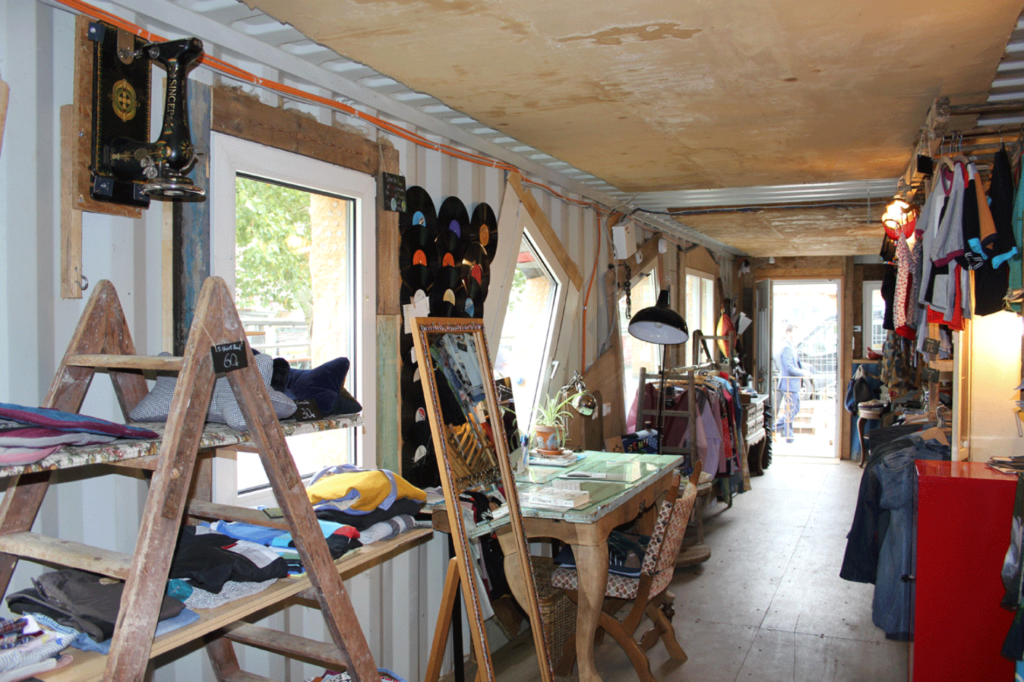
Inside view of the shopping area of BENU village. Source: https://www.moien.lu/benu-village-franz-fayot/

Required resources

BENU village benefits from seed funding of the Ministry of Energy and Spatial Planning and the City of Esch-sur-Alzette, where the initiative is located. Apart from the financial support, the project was realised with the support of volunteers, that helped in the building and organisation of BENU village. As the building materials were mostly recycled, no material costs arised from the implementation of the project.

Results

The numbers speak for the success of the eco-villager: in 2019, a turnover of EUR 210,000 was generated, with 18 persons working for BENU village. About EUR 80,000 were generated from upcycled clothing and accessories. And BENU village will soon grow further. In 2021, when more surfaces of BENU village will become available, they will be rented to professionals pursuing similar ideas. Interested businesses, that act in line with the BENU Charta, can then rent these spaces. This way, BENU village will develop into a coworking space of likeminded professionals and businesses.

BENU village shows that there are different interpretations of the often referred-to ‘circular economy’. In addition to the mainstream definition, applied mostly at regional and national level, the definition of BENU village is different. BENU village shows an alternative reading to circular economy that functions at small scale and yields more than just a decrease in material consumption.
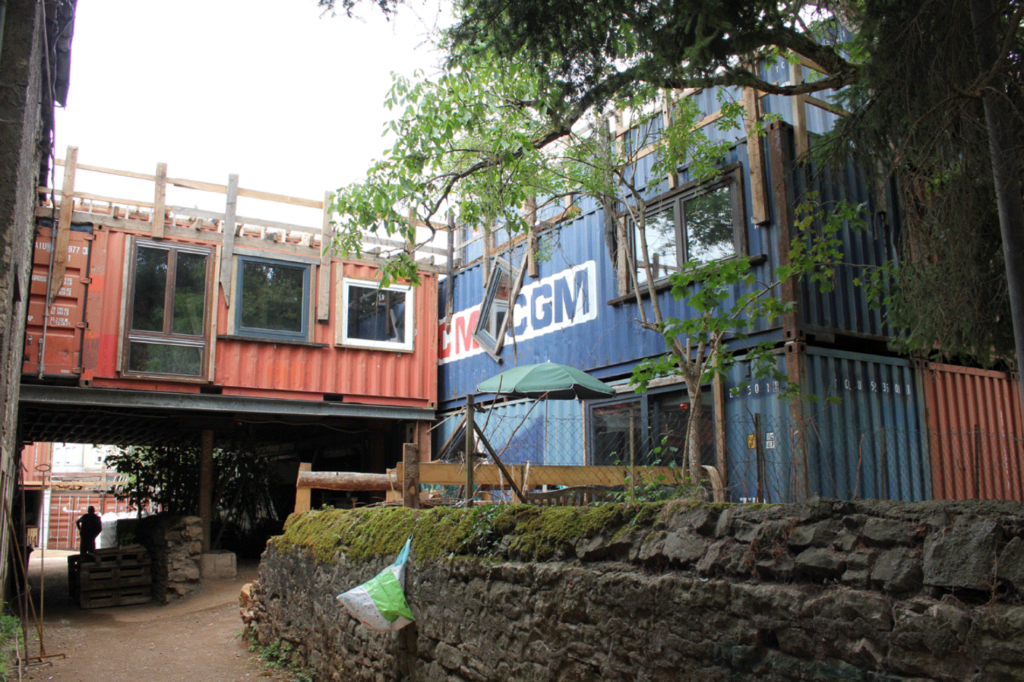
Outside view of the container structure of BENU village. Source: https://www.moien.lu/benu-village-franz-fayot/

Experiences, success factors, risks

As with many grassroot movements, the private commitment to the underlaying idea is important for the success of a project. The idea for BENU village was initiated and implemented by a private person. The continued lobbying and defence of the idea has successfully yielded the interest of elected officially, such as several national ministers and even the Grand Duke of Luxembourg.

In 2021, the project was awarded with the European Climate Star from the Climate Alliance in the category ‘Saving resources’. A short video is available here.

Conclusions

BENU village shows an alternative to our current living and working in an affluent society. Ideas such as ‘zero waste’ can also be successfully implemented with relatively little resources at district level. However, for doing so one needs pioneers and “BENU is a pioneer”, as described by the national Minister for Energy and Spatial Planning, Turmes.

The idea behind BENU is versatile and can be applied for more than just material production. During 2021, a restaurant, following the BENU Charta will open at the premises of BENU village.

Contact

General E-Mail address of BENU village Esch asbl: benu@benuvillageesch.lu

References

BENU, 2020: Website of BENU village Esch (in English): http://benu.lu/en/

Taylor Aiken, Schulz & Schmid, 2020: The community economies of Esch-sur-Alzette: rereading the economy of Luxembourg (scientific article in English): https://orbilu.uni.lu/handle/10993/42602
Blog CIPU

Luxembourg City « Baulückenprogramm »: a city taking action against vacant lots

>

About 30% of land in the city of Luxembourg is owned by the municipality. Only about 246 of the publicly owned 1 600 hectares are classified in the local land use plan as building land, being connected to infrastructure and available for construction. With continuously increasing pressure on the housing market, the municipality is creating affordable housing for its citizens, through developing the ‘Baulückenprogramm’.

Rationale for action

Tackling the housing shortage is a key priority in Luxembourg overall, but especially in the capital, Luxembourg city, which is the main pole of attraction for people and businesses. By constructing affordable housing, the municipality can select tenants and owners from specific socio-economic groups. Developing vacant lots within the city can also avoid urban sprawl.

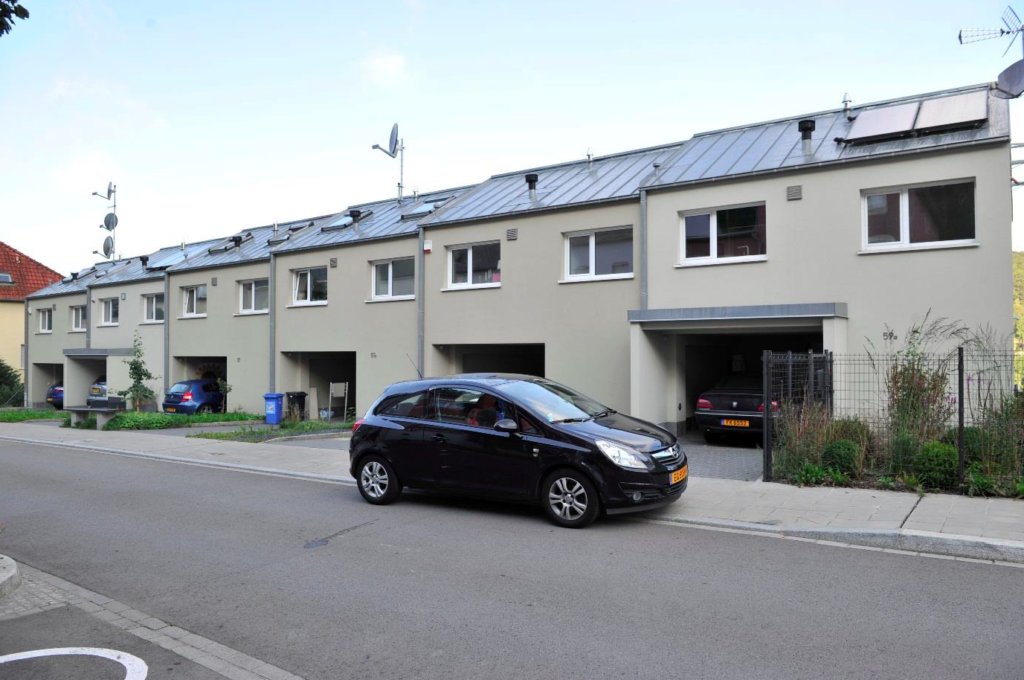
Houses built during the 1st iteration of the ‘Baulücken’ programme in 53-59, rue Schetzel.

Objective

The Luxembourg city ‘Baulückenprogramm’ uses vacant lots owned by the municipality to construct affordable housing. Developing such areas does not require long administrative procedures so construction can begin relatively quickly. More housing units can be created without developing land outside the existing urban fabric.

Time frame

There have been three rounds from 2006 to today (2021). The ‘Baulückenprogramm’ was first initiative of its kind in the country.

Key players

A joint working group of the municipality of Luxembourg (political players and municipal employees), Ministry of Housing and OAI (an organisation of architects and consulting engineers) organise the process and decide on proposals.

With the ‘Baulückenprogramm’, the municipality cooperates with private enterprises, architects and property developers. Developing concepts and plans for the vacant lots, while construction is organised through public procurement. Architects submit proposals for the housing design and private developers for the construction.

Implementation steps and processes

The ‘Baulückenprogramm’ is an umbrella term covering several implementation steps. The programme identifies vacant lots and implementation involves several rounds of planning and construction.

The municipality began identifying vacant lots based on information from satellite imagery, the land register and the local land-use plan. 73 potential sites were identified, for which district and individual records were created. Based on this information, the sites were presented to a working group, which selected the vacant lots to be developed.

The units are planned and realised in cooperation with architects and private real estate developers who build and sell the accommodation. The obligations and duties of developers are laid down in a contract with the municipality, clarifying the terms and conditions of transferring the units to future owners.

The units are allocated to residents through predefined selection criteria. A comprehensible and transparent checklist for each applicant allocates points based on individual socio-economic factors. A higher score indicates a greater possibility of being chosen as a future owner.

The selection criteria include the applicant’s age, family situation, working location and number of consecutive years lived in the city. There is a maximum score of 19 points (< 30 years of age, > 3 children, working in Luxembourg, living consecutively in the city for more than five years) and a minimum score of three points (> 45 years of age, no children, not working in Luxembourg, not living consecutively for more than five years in the city).

The units are sold through heredity leaseholds of 99 years. On a single lump-sum payment, the building land is transferred from the municipality to the developer (and finally to the future owner) and an annual user fee is required for the accommodation. Owners must personally reside in the units and cannot rent the property to a third person. The municipality also keeps a preemption right on all accommodation.

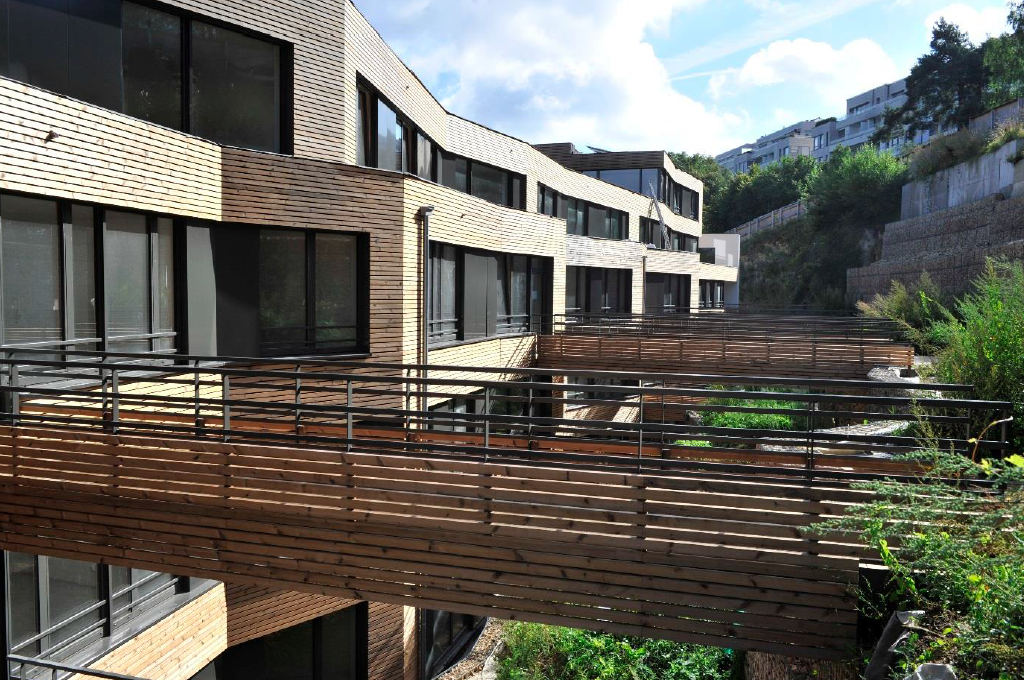
Apartment house built during the 2nd iteration of the ‘Baulücken’ programme in 1-13, rue des Forains.

Results

The first round of the ‘Baulückenprogramm’ was in 2006 for nine vacant lots. Construction finished in 2010. The second round was initiated in 2010 for four lots, which was finalised in 2015. The last and current round started in 2013 for five lots and construction have been finalised in 2018.

During the first round (2006-2010), 75 accommodations were built including 18 single family homes. The second round created 58 apartments (2010-2015) and in the third round 64 units were completed in 2018. In all 197 accommodations have been realised through the ‘Baulückenprogramm’ so far. All units built during the first two rounds were sold to individuals. About half the accommodation in the third round will also be sold with the rest to be rented as social housing or affordable housing. All units follow state of the art building techniques and design principles.

Experiences, success factors, risks

The ‘Baulückenprogramm’ shows that municipalities in Luxembourg have an effective instrument to directly shape the supply of affordable and social housing. Emphasising building quality and design ensures residential buildings are integrated into their surroundings.

The programme was realised on vacant lots owned by the municipality. The majority of vacant lots in Luxembourg city are however owned by private individuals. The ‘Baulückenprogramm’ is a useful instrument to address the shortage of affordable housing in publicly owned areas. To mobilise private lots, other instruments and steps might be necessary.

Apartment house built during the 2nd iteration of the ‘Baulücken’ programme in 39bis, rue de Cessange.

Conclusions

The ‘Baulückenprogramm’ has seen the municipality pro-actively create affordable housing for residents. This enables the municipality to select future owners individually, offering affordable housing for specific socio-economic groups.

Contact

Urban development service,City of Luxembourg: urbandevelopment@vdl.lu

References

Presentation Ville de Luxembourg « Baulückenprogramm » (in French): https://docplayer.fr/23010248-Baulucken-historique.html

Blog CIPU

Fonds du Logement: a public agency as residential development company

>

Fonds du Logement is the national fund for housing. It was established in 1979 and acts as a residential development company for Luxembourg.

Rationale for action

Housing prices in Luxembourg have increased steadily over the past 20 years. Among other reasons this is caused by a mismatch in supply and demand. High demand and limited supply had a multiplying effect on prices for housing. It has become increasingly difficult for large parts of the population to find housing, as the increase of their household incomes does not match the increase in property prices.

In 2013, a study identified that approximately 30 000 households need affordable housing within the country. This compares to a total of 4 000 subsidised units currently offered by public authorities.

Objective

With the creation of Fonds du Logement, the state implemented a public institution. The Fund follows the principle of a non-profit organisation that acts on behalf of the general public interest.

The Fund fulfils several tasks:

  1. Renting out housing to people who are financially disadvantaged (i.e. providing social housing) and selling housing to people that are eligible for a housing construction premium (i.e. providing subventioned housing) through sale, leasehold or a combination of both.
  2. The above task includes supporting the tenants and the family members of social housing units the Fund provides. In other words, the Fund assists tenants in fulfilling their obligations as renters. This reduces conflicts between tenants and ensures harmonious cohabitation within the buildings of Fonds du Logement and integration into the residential surrounding.
  3. The Fund can also execute all other tasks in relation to housing projects of general public interest. The involvement is subject to agreement between the state and Fonds du Logement.
  4. To guarantee functional and social mix in the districts where the Fund implements its tasks, Fonds du Logement can acquire, create, renovate, sell, rent or transfer surfaces of commercial, social or professional purposes. This applies for social, subventioned and non-subventioned housing. In complexes where Fonds du Logement sells or rents individual parts, it can act as trustee.
  5. Implementing its tasks, the Fund can act individually or in cooperation with any other public or private entity. It is also equipped with the possibility to apply preemption and redemption rights on all of its sales for up to 99 years.
  6. In accordance with the European Commission regulation on state-aid rules the mission of Fonds du Logement on general public service provision is limited to 99 years.

In general, the Fonds du Logement enlarges and maintains through its actions the public housing inventory dedicated for sale and for rentals. The Fund has the legal autonomy to develop by itself or in cooperation with municipalities, housing within the framework of existing municipal land-use plans.

Fonds du Logement logo. Source: Fonds fu Logement.

Time frame

1979 – today (2021)

Key players

Municipalities where projects are implemented, the state through the Ministry of Housing, architects and building companies in charge of implementation.

Implementation steps and processes

Fonds du Logement, in its capacity as a public residential development company, benefits from several legal advantages. It is attributed with a preemption right on land sales. For the units it has built, the Fund has the autonomy to contractually implement preemption, repurchase and redemption rights. The corresponding sales price is evaluated for each unit individually. By developing and enlarging the inventory of publicly owned subsidised housing, the Fund exercises the function of a public developer.

Tenants and buyers of units provided by Fonds du Logement benefit from subsidised prices. The Fund also leases units without intermediaries, supervising and supporting tenants of the social housing units. It therefore acts not only as a public developer but also executes social tasks.

Required resources

The Fund benefits from an annual budget provided by the state. During 2019, the budget amounted to EUR 507 million. More information can be accessed on the website of the Fund.

Results

The Fund owns and administers currently approximately 2 000 housing units and since its establishment, it has sold about 1 700 accommodations. With the recently initiated large-scale development projects, the number of housing units is expected to increase significantly during the coming years. Fonds du Logement is currently a major stakeholder in three major urban development projects, notably in Wiltz (Wunne mat der Wooltz), Esch-sur-Alzette (Nonnewisen) and Dudelange (‘NeiSchmelz’).

The Fund also guarantees a mix between functions in the projects it implements. An example therefore is the newly created district Nonnewisen in the city of Esch-sur-Alzette. Fonds du Logement was involved in creating housing as well as commercial surfaces for shops and businesses.

Experiences, success factors, risks

The recent rise in public development projects is expected to address the demand for affordable housing incrementally. Therefore, Fonds du Logement is also working on large-scale projects. Ongoing large-scale projects ‘Nonnewisen’, ‘Neischmelz’ and ‘Wunne mat der Wooltz’ in which the Fund is involved, will each accommodate between 1 800 and 2 000 residents. These projects will substantially help to satisfy parts of the demand for housing in the areas where they are implemented. The large-scale projects are implemented through innovative urban development techniques and processes that are based on the principles of circular economy.

In general, it is difficult for large-scale projects to integrate easily into the surrounding urban and social pattern. The sheer size of such developments in comparison to the surrounding creates new challenges. For example, ‘Wunne mat der Wooltz’ will create housing for 1 800 people, increasing the current population of the municipality of Wiltz in the north of the country by some 30%.

Conclusions

A public agency serving as a counterweight to the housing market is essential to provide social and affordable housing. Because of lower profit margins, private developers usually have little interest in creating housing for lower income households, leading to a market failure. Public institutions such as Fonds du Logement must mitigate this to avoid segregation and social marginalisation.

Contact

General E-mail address: info@fondsdulogement.lu

References

2019 Fonds du Logement annual report (in French)

Fonds du Logement Website

Blog CIPU

LENOZ – A sustainability certification system for residential buildings

>

LENOZ (Luxembourgish: ‘Lëtzebuerger Nohaltegkeets Zertifizéierung fir Wunngebaier’, English: Luxembourg residential building sustainability certification) was introduced in 2016. Through LENOZ, the Ministry of Housing is following the recent trend of establishing sustainability certification systems for buildings and building techniques. LENOZ targets official and comparable certification of good practices, to make them more popular. At the same time, the certification can be used to as certification accessing construction and renovation funds.

Rationale for action

For over 40 years, energy consumption has been a quality and sustainability criteria for buildings. Energy consumption alone however does not provide sufficient information on the environmental impact of a building. Important features, such as materials and location also influence the sustainability rating.

The vast variety of construction techniques and materials make it difficult to assess the quality of a building. This applies especially to private developers who make up a large share of the building sector but who need training in assessing the quality of buildings.

LENOZ therefore combines two certification approaches for residential buildings. It certifies the quality of the building and also assesses the environmental impact of a dwelling and its construction process.

Objective

In doing so, LENOZ provides guidance for developers and owners on the quality and the environmental impact of their dwelling. Certification can be for new construction, or for existing projects, i.e. renovations. Based on simple, comprehensible criteria, LENOZ provides information for new projects or improvements to existing buildings.

LENOZ certification can equally be used to promote good practices in sustainable and high quality building techniques and materials. The aim is to increase awareness of dwelling quality and sustainability for housing owners and builders.

Additionally, LENOZ can also introduce common certification standards for the public sector, private builders, renovators and construction companies.

Time frame

LENOZ certification was introduced in 2017.

Key players

The players behind LENOZ is the Ministry of Housing as well as building owners and builders.

Implementation steps and processes

LENOZ evaluates six categories; 1) location, 2) social function, 3) energy consumption and costs, 4) ecology, 5) building and technical equipment and 6) functionality. For each category there are several topics and criteria, giving a total of 37 topics and 143 criteria.

Many criteria are binary, with ‘yes’ or ‘no’ answers. This facilitates understanding of the certification for individuals. LENOZ certification is organised around four sustainability classes for housing projects with up to four points for projects in the highest class.

Anyone interested in certifying a dwelling can use information from LENOZ to design the project in cooperation with an architect or an energy consultant. This way, the project can follow the best LENOZ criteria. Applications for certification are submitted to the Ministry of Housing. Finalised projects can also be certified through LENOZ. The six evaluation categories highlight different features of housing projects.

Category 1 ‘location’ is innovative as it complements standard building classifications of energy or materials used (categories 3 and 4). For the location, LENOZ includes spatial planning principles in the evaluation. Under this category, dwellings gain additional points if they are in a decentralised development centre in the country or were developed on a vacant lot within a settlement structure. Dwellings in municipalities certified by ‘KlimaPakt’ (Climate pact) receive additional points.

Based on the total number of points attributed, a different certification level for buildings is issued. There’s a total of four classes, each corresponding to a level of achievement for the evaluated building. Class 1 for ‘very high sustainability’ is attributed for buildings achieving more than 85% for all categories, class 2 for ‘high sustainability’ for buildings achieving between 70% and 85%, class 3 for ‘good sustainability’ for buildings achieving between 55% and 70% and class 4 for ‘minimal sustainability’ for buildings achieving below 55% for all categories.

LENOZ certification label. Source: Ministry of Housing, 2019.

Required resources

Owners and homebuilders looking to certify dwellings through LENOZ are supported financially, with EUR 750 per apartment in a multi-apartment house and EUR 1 500 for a single-family home. There is no information on the costs for setting up LENOZ.

Results

LENOZ combines different certification approaches and also uses existing certifications. For example, data from the ‘energy passport’ is used for certain criteria. Since 2010, the energy passport has been mandatory for all buildings on sale or for rent in Luxembourg. The certification of dwellings through LENOZ remains optional.

Experiences, success factors, risks

LENOZ’s broad categories enable a ‘one-size-fits-all’ certification addressing several objectives, issues and features for housing development. By integrating ‘location’ for instance, houses that reduce or limit urban sprawl receive a better certification.

Certification can be used for different purposes. For instance, LENOZ is currently used to access the PRIMe House programme where the Ministry of Energy and Spatial Planning financially supports sustainable, energy efficient dwellings.

Conclusion

LENOZ follows a new, comprehensive and combined approach to certifying housing projects. It was only introduced 2017, so uptake can be better seen by reviewing the following years.

Contact

Ms Annick Rock, Ministry of Housing: annick.rock@ml.etat.lu

LENOZ general contact address, Ministry of Housing: lenoz@ml.etat.lu

Further reading

Ministry of Housing, 2021: LENOZ information site (in French): https://logement.public.lu/fr/professionnels/promoteurs-sociaux/logement-durable0/classification.html

Ministry of Housing, 2019: Explanatory manual (in French): https://logement.public.lu/dam-assets/documents/publications/lenoz/lenoz-manuel-explicatif.pdf

Ministry of Housing, 2019: Procedure for requesting a LENOZ certification: https://guichet.public.lu/en/entreprises/urbanisme-environnement/energie/energie/certificat-lenoz.html

Blog CIPU

The « Planungshandbuch »: A planning manual from Luxembourg on how to develop high-quality urban districts

>

In the Grand Duchy of Luxembourg, 2 + 3 = 1!

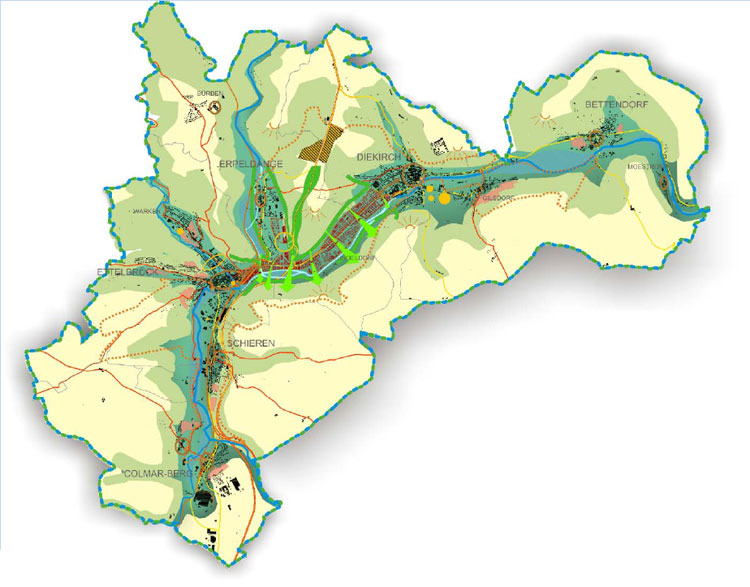
The cities of Ettelbruck and Diekirch, both located in the North of the Grand Duchy, are not far from another. The borders of the two cities are only 2 kilometres apart. Their settlement structure and those of the three neighbouring municipalities form a nearly continuous urban fabric. Many decision-makers have raised the question of why not merging forces and territory and creating the new capital city of the North?

Merging the five municipalities into a new economic powerhouse of the North, the so-called NORDSTAD, has been discussed for a long time. Two masterplans were developed, detailing roughly the urban concept for the existing settlements and earmarked areas that will be urbanised.

For various reasons, the idea to create the NORDSTAD has not yet materialised: municipal mergers and the creation of a new city need to be well thought out and the individual steps take time. One of the main hurdles was overcome in summer 2020, when all five mayors signed a memorandum of understanding to become the NORDSTAD. With their signature, the mayors have entrusted a municipal syndicate to further the idea of creating the new city. Thus, it is not a question of ‘if’ but of ‘when’ they will become the NORDTAD.

Masterplan for the creation of the NORDSTAD. Source: NORDSTAD, 2021.

But how does one realise 2 + 3 = 1?

The typology and structure of buildings in Ettelbruck and Diekirch features low densities and pays tribute to their 8,800 and 6,800 inhabitants. Many single-family houses, number of floors seldomly exceeding five stories and a rather old building structure characterise the urban pattern. The three neighbouring municipalities Bettendorf, Erpeldange and Schieren feature many single-family houses. To transform the cities and the municipalities into one major urban pole, a lot of yet unused land will be developed.

When planning for the creation of new districts or new cities in Luxembourg, planners and architects opted for high-density structures during the past. The ‘Belval’ district in Esch-sur-Alzette and the ‘Kirchberg’ district in Luxembourg City are two examples. What makes them distinct of the NORDSTAD is that they are extensions of existing urban tissues with large numbers of inhabitants.

NORDSTAD will be different: Ettelbruck and Diekirch are small cities and high-density developments risk of destroying the areas’ properties and characteristics. For creating the NORDSTAD, a new type of ‘urbanity’ is necessary.

The new type of urbanity for the development of the NORDSTAD needs to meet different criteria: it needs to avoid ‘over-urbanisation’ and ensure high quality of life for future and current residents, provide adequate housing and public places and ensure the integration of existing districts into the new settlement pattern. The village-character of the two cities needs to be preserved for any future development. And finally, a major challenge planners and architects need to solve is “How to create ‘urbanity’ from the drawing board for the areas that ought to be developed?” The reflections and plans drawn up for the NORDSTAD have answered important questions that resulted in a lot of good practices.

Projects like the NORDSTAD, where a significant amount of fallow land is being developed, have become a frequent encounter in Luxembourg. Decision-makers, planners and architects need to make choices at many different levels, from the local land-use plan down to individual buildings. Especially in smaller municipalities with limited staff and expertise in urbanising areas, support and guidance was required, helping municipalities in making better choices.

In comes the so-called “Planungshandbuch”, a guideline for the urbanisation of cities and villages, developed at the example of NORDSTAD. The term is German for ‘Planning Manual’ and the document functions as such: it gives concrete guidance on the future looks, feels and properties of areas that ought to be developed. It is targeted at planners, architects, technicians, decision-makers as well as citizens. The ‘Planning Manual’ is structured in nine overarching chapters that address several topics when planning in urban areas: urban development, functional mix, building layout, public infrastructure, mobility, parking, layout of public spaces, nature protection and quality of housing. Under all these topics, the manual provides concrete design ideas and recommendations in an illustrative way.


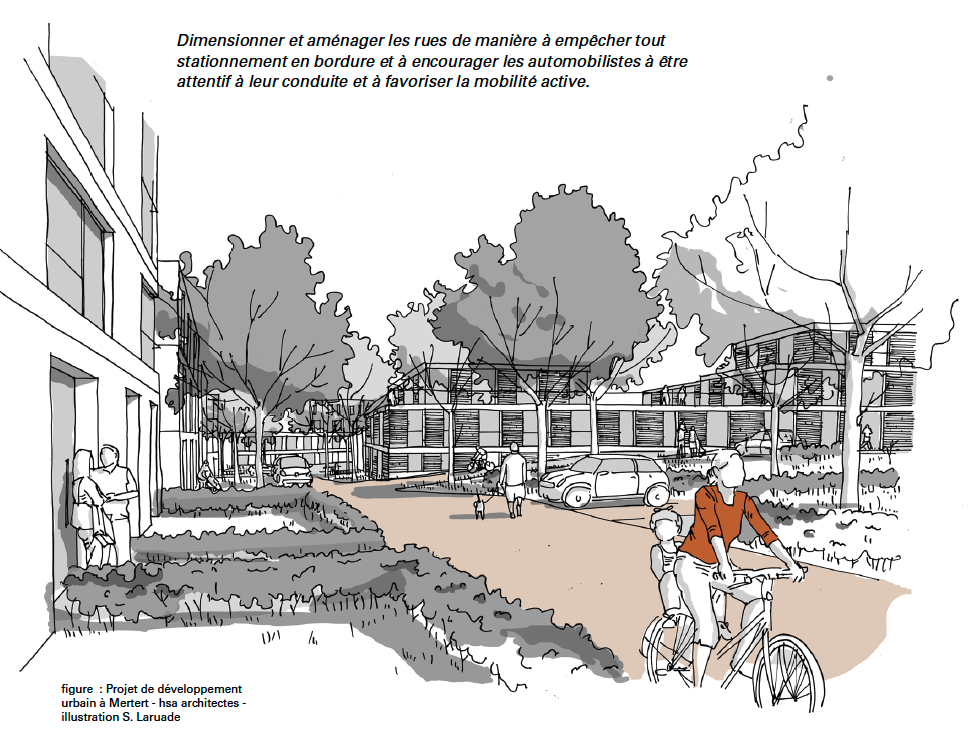
The illustration shows a proposed layout for public and semi-public areas from the ‘Planning Manual’. Open places in front of building entrances allow residents to meet and to chat. Narrow streets and limited parking slots while providing good access via soft means of transport, reduces need for motorised forms of mobility. Source: Planungshandbuch, 2021.

The presented ideas were drawn from the experience of urban planners in the NORDSTAD and in other Luxembourgish convention areas. Convention areas are associations between the state and municipalities to ensure territorially integrated development across administrative levels and borders in the country. The ‘Planning Manual’ thus draws from the knowledge and lessons learned from concrete examples.


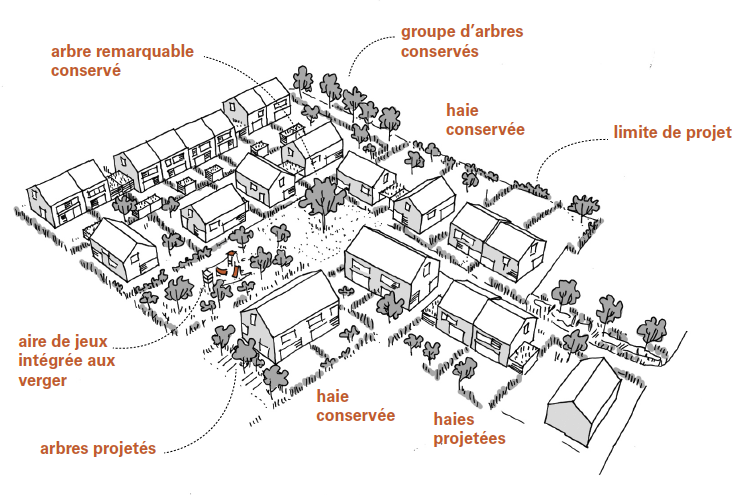
The illustration shows a proposed green space concept for districts from the ‘Planning Manual’. A mix of private and public gardens creates privacy and areas where residents can meet. Existing trees and hedges are integrated into the districts. Source: Planungshandbuch, 2021.

The document is unique as it gives guidance to planners and architects long before decisions on the exact layout of new districts are taken. Even if districts are planned and implemented by different planners and architects, they will have similar looks and feels and a common character. This will convey a feeling of a common identity amongst future residents of different districts. Such a guideline also allows to include important features such as quality of life or sustainability from the very beginning in district development.


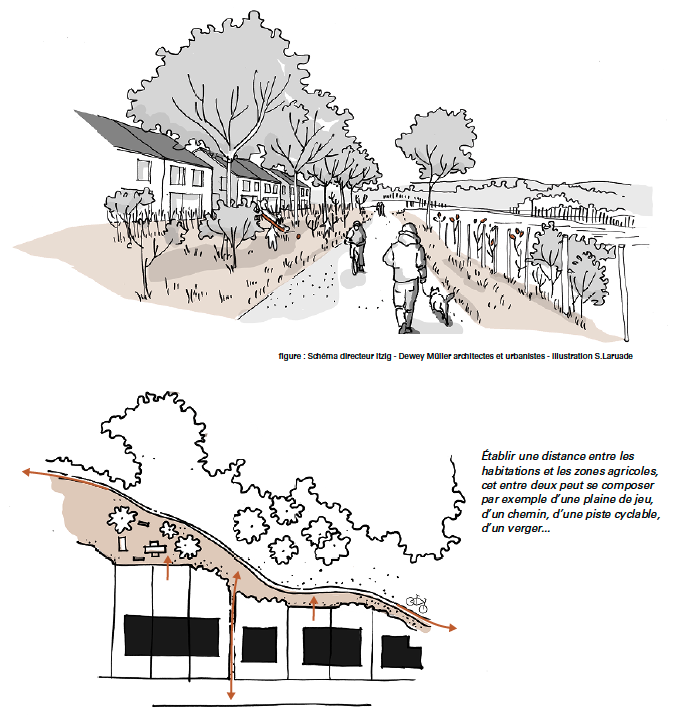
The illustration shows a proposed concept to combine private, mixed and public from the ‘Planning Manual’. Small access paths that connect several private gardens and shared meeting areas for neighbours create transition areas between private and public gardens. Source: Planungshandbuch, 2021.

Also, the ‘Planning Manual’ with its comprehensible texts and numerous illustrations gives planners a new tool for public participation. Breaking down urbanistic guidance from complex 2D and 3D renderings to drawings and pictures allows residents much easier to understand urban design. Residents can thus raise their voice and work together with architects and planners on integrating their wishes and need in the future development. In turn, this helps to reduce often observed phenomenon like ‘NIMBY’ (‘Not In My Back Yard’) and increases identification of residents with their future districts.

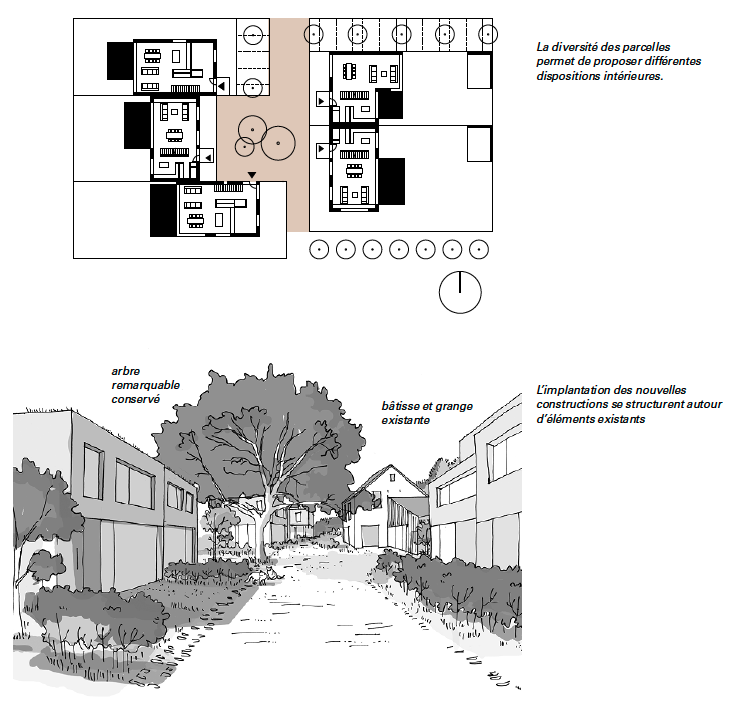
The illustration shows a proposed concept for a neighbourhood from the ‘Planning Manual’. Mixed building typology and a central place to meet allows for functional and social mix of areas. Source: Planungshandbuch, 2021.

If you are interested further, please find here the complete planning manual, allowing to get a more comprehensive picture of recommendations and guidance to urban development in Luxembourg.

In conclusion, the “Planungshandbuch” provides orientation to planners, citizens and decision-makers on the future looks and feels of districts that ought to be developed. It clearly points at good practices and things to avoid and capitalises the knowledge created during discussions of planners, architects and decision-makers in the framework of the NORDSTAD project. The manual allows to visualise and include elements of urban design from the very beginning into planning processes. This helps to create high quality urban environments across the country, respecting principles of a sustainable urban development and ensures a high quality of life in future urban districts.


Blog CIPU

Project presentation: ‘PAP Molter’ or municipalities issuing specific implementation plans

>

Mondercange is the gateway to the former mining district in the industrial south of the country. As other municialities in Luxembourg, Mondercange has relatively high costs for living. The municipality has identified and implemented a special way of developing affordable housing for its residents.

Rationale for action

Mondercange lies in the densely populated southern part of the country where there is high demand for housing, including high demand for affordable housing. To provide affordable housing for its residents, the municipality of Mondercange has targeted an unused area of 4.15 hectares for development within the town. The objective of this development project, called Molter, is to create a residential district dedicated to affordable housing including a large park.

Objective

In developing this area, the municipality has chosen a special way of creating housing. Issuing building permits in Luxembourg depends on lots being developed with a specific land-use plan (PAP). The PAP specifies aspects of construction, such as density, roof form, parking, etc. and follows provisions laid out in the general land-use plan (PAG), which is valid for the entire municipality. The normal procedure in Luxembourg is for a private developer to create the PAP by contracting an urban planner or an architect. The expert then ensures the public provisions and private plans for the site are compatible. For the Molter PAP, the municipal administration contracted an urban planner. He then planned the new district respecting the public provisions and translating the development concept from the municipality into a concrete development plan. 

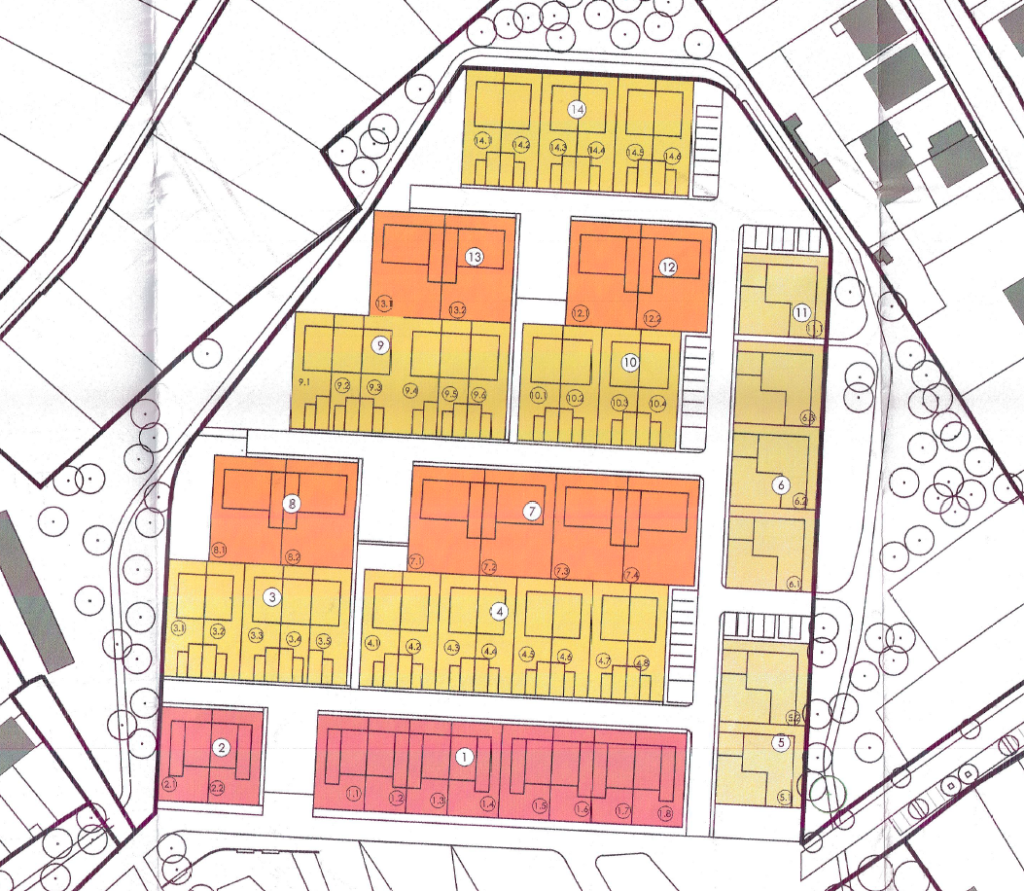
PAP Molter, building layout from the specific land-use plan. Source: Municipality of Mondercange.

Time frame

The PAP were developed between 2011 and 2012. After their approval in 2013, construction started until the project was realised in 2017.

Key players

Key players are the municipal administration of Mondercange, urban planning bureaus and SNHBM (the national association for affordable housing).

Implementation steps and processes

The process started with defining criteria for the plot to decide on the future use of the area. The emphasis was put on affordable housing for specific population groups. The allocation of the housing units will depend on the applicant’s age, number of years lived in the municipality and children in the household. Additionally, the housing will be available for families that do not have property yet and that are eligible for a construction premium, as defined by the Ministry of Housing. So, the units are for people in real need of affordable housing. Once the criteria and conditions were established, the municipality tendered the planning procedure. Construction was realised by SNHBM, between 2013 and 2017.

Required resources

Municipalities implementing such approaches must invest more time and money. If a developer creates the PAP, the role of the municipality is limited to the approval procedure. After that it has limited possibilities to influence future use of the plot.

The project illustrates that municipalities creating PAP independently have a strong planning tool at hand. This pre-supposes willingness to invest time and effort. The municipality of Mondercange had to allocate financial resources and labour input to manage the process. The process included managing the procurement and coordinating the cooperation with SNHBM. The urbanistic office (service urbanisme) of Mondercange was in charge of the process. Such a planning process comes at a cost but provides significant added-value for the municipality by making it possible to actively shape developments.

Results

As the municipality has created the PAP, it was possible for the administration to lay out provisions for the site. Mondercange thus created a new district to its own design with 55 single family houses within the municipality. The price per square metre for these houses is lower than the average price for housing in the country of Luxembourg. New and old residents also benefit from a new, large park that was built in the centre of the new district.

Experiences, success factors, risks

The approach is a positive way to develop municipal land. Generally, this requires more efforts (for coordination and procurement of the planning process) but it provides significant opportunities for municipal administrations to actively shape the urban pattern. The case of Mondercange also illustrates how political priorities in the field of affordable housing can be realised through concrete projects in the municipality.

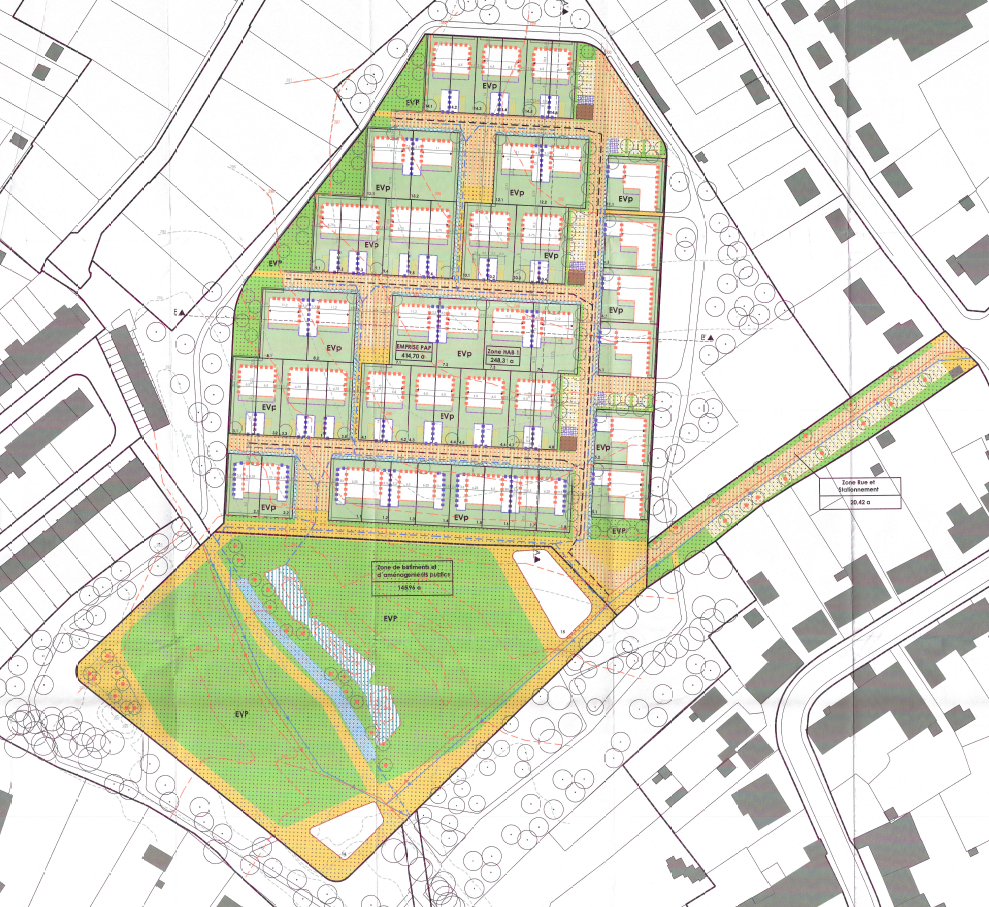
PAP Molter, building layout and the park area from the specific land-use plan. Source: Municipality of Mondercange.

Conclusion

A stable political and administrative framework for local experts and urban planners is key. Such projects usually take longer than a single legislative period. Additionally, the project shows a way of cooperating between different levels of decision-making. SNHBM, a national actor and the municipality of Mondercange as the local stakeholder, have managed to create affordable housing, bypassing market influences. This is important, as private developers are usually less motivated to create affordable housing.

Contacts

Municipal administration of Mondercange: commune@mondercange.lu

Blog CIPU

Project presentation: Developing the new urban district « Nonnewisen » in Esch-sur-Alzette

>

Nonnewisen is a development in Esch-sur-Alzette, the second biggest city of Luxembourg, in the South of the country. The development covers 30 hectares of previously agricultural and horticultural land at the northern outskirts of the municipality.

Rationale for action

In Esch-sur-Alzette, prices for housing increased continuously in recent years following the national trend. This has been boosted by the large-scale development of Belval, a former steel-production site close-by, now converted into a new city district. To address the shortage of affordable housing, the municipality of Esch-sur-Alzette in cooperation with Fonds du Logement (the national housing fund) initiated conversion of the site from agricultural land and allotments into a residential area.

Objective

Nonnewisen is a new district, integrated into the existing urban fabric. When finalised, it will provide around 900 highly modern housing units, hosting 2 300 to 2 500 inhabitants. Providing a high standard of living in the new district is one of the main objectives. Because the district is part of the existing urban fabric of the city. A high population density for the new district is envisaged. To ensure a high quality of life, emphasis was put on high quality green urban areas as recreational sites between and within buildings.

Additionally, the functional mix between living, working, recreation and consuming provides a high level of service for residents. There will be a new school for 300 to 320 students, a day care centre and a central space with shops. Blending different functions ensures that services will be easily accessible by soft means of transport and the site will also be a centre of attraction for the older, surrounding districts.

Another priority was to keep unit costs low. This was achieved by constructing high density buildings, saving material and effort. Economies of scale reduce construction costs. The municipality together with Fonds du Logement allocate residential units directly, excluding real estate agencies, which makes it possible to determine prices independently of market influences.

Timeframe

The project is being developed since 2003. Development of the district is still ongoing in 2021.

Key players

Fonds du Logement is in charge for creating a third and the Municipality of Esch-sur-Alzette is in charge of creating two thirds of the planned accommodation. A large number of planners and architects, private as well as public land land owners are also involved.

Implementation steps and processes

In 2003, the first call for proposals for an urban concept was launched, which was awarded to a Dutch firm. A key criterion was that the new area and buildings integrate well with the surrounding urban fabric. Building the new area following the state of the art construction techniques was equally important as environmental protection in the design of the concept.

For the implementation, the terrain was acquired. Around 20 hectares were already owned by the municipality of Esch-sur-Alzette and a small piece of land belonged to the state. The rest is being bought piece-by-piece from the private owners. Even though development has started in some areas, negotiations with owners of other areas are still ongoing. In 2007, construction of the first units started and in 2011 the first part with 17 apartments and 23 single-family houses was inaugurated by Fonds du Logement. In 2012, another 25 single-family houses, 4 double family-houses and 42 student residences were finalised. In 2015, the third phase provided 32 single-family houses, 24 apartments and ~500 m2 of commercial space. In 2017, 8 commercial spaces, 40 more single-family homes and 75 apartments have been completed.

Buyers of subsidised units provided by Fonds du Logement need to be eligible for a housing construction bonus from the state. This is linked to social criteria such as a below-average household income. Under this, 130m2 of subsidised housing costs around EUR 444 000, or some EUR 1 000 per m2 below the average price in Luxembourg in 2016. Such buyers can also access other financial support. Non-subsidised units can be purchased by anyone and 130 m2 of non-subsidised housing costs around EUR 472 000.

Units can only be bought for a term of 99 years. This is through heredity leasehold that costs around EUR 50 per month. People need to live at least 20 years in the units before they can sell their property again and Fonds du Logement has unconditional pre-emption right. Units sold by the municipality (2/3 of the total units built) can be purchased for a lower price. They are sold without heredity leasehold and thus do not include a usage restriction on 99 years.

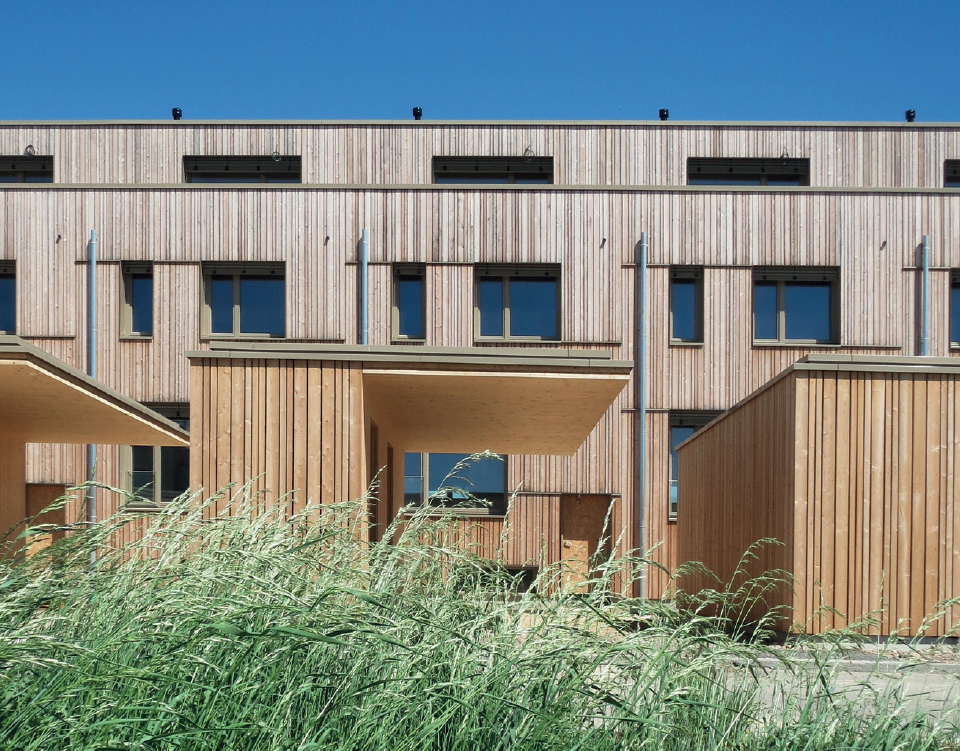
Type of wooden single-family houses in the new district. Source: Fonds du Logement, 2020.

Required resources

The development of the new district is organised in stages. The project is not yet completed so total costs are still unknown. As an example, the price for the third phase (32 single-family houses, 24 apartments and ~500 m2 of commercial space) was EUR 17.5 million.

Results

The new district offers residents an attractive environment with a high quality of life. It borders many public green spaces and is close to the city centre of Esch-sur-Alzette. The new district is well connected to surrounding districts as new infrastructure has been created within and towards Nonnewisen and so far the mix of functions promises to be successful.

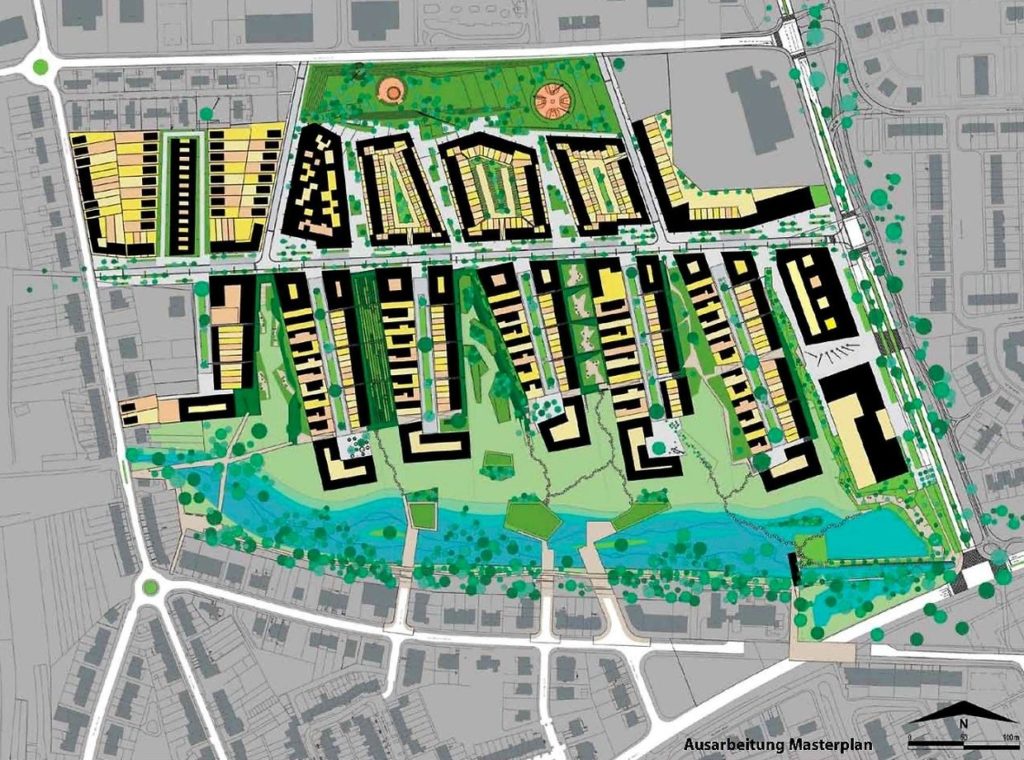
Nonnewisen development plan ‘urban gardens’. Source: City of Esch-sur-Alzette, Fonds du Logement, 2003.

Experiences, success factors, risk factors

The development shows how an urban environment can be shaped to provide liveable and affordable housing. All proposals submitted in 2003 under the limited competition procedure were in line with the primary requirements of the public institutions that have triggered the development (the municipality and Fonds du Logement). A cooperative competition process permitted the authorities and tenderers to find common solutions to identified problems. During the planning and implementation of the project, the municipality worked closely together with the Fonds du Logement. The stepwise approach of the developments ensures that the construction of the new district does not overburden the resources at hand.

Nonnewisen is also an innovative design concept. Issues, resulting from high density were structurally addressed in the planning process by providing areas where residents can meet and where they remain alone.

Conclusions

Nonnewisen illustrates how innovative urban forms of housing can look in the future and that high densities are no rejection to a high standard of living. A pre-condition for the development of the site was the ownership structure. Most of the area needed for the development of Nonnewisen is public property and only some areas have to be purchased from private owners. Considering future adaptions of the structure of the district, the recreational green areas are important in order to sustain a quality of life in Nonnewisen.

Contact

Ms Daisy Wagner, chief planner of the city of Esch-sur-Alzette: Daisy.Wagner@villeesch.lu

Blog CIPU

Project presentation: Master plan ‘Wunne mat der Wooltz’ in Wiltz

>

Wiltz is a city in the north of the Grand Duchy of Luxembourg. The city is the only urban centre with more than 7 000 inhabitants in the sparsely populated north and is therefore classified as a national centre of attraction. Until 2030, the municipality and the state would like to see an increase of population to reinforce the city’s position as ‘capital of the north’. One step in this is a master plan for developing a 25.5 hectare district in the city centre, called ‘Wunne mat der Wooltz’.

Rationale for action

The area covered by the master plan lies between Oberwiltz and Niederwiltz and was an industrial area with many factories. The area experienced a downturn when structural changes decreased the demand for industrial goods. Already in 1996 the municipality has identified the need to develop this district next to the city centre.

The master plan shall help developing Wiltz as the capital of the North by attracting more inhabitants and jobs. This is in line with the decentralisation objectives and the ‘CAP 2030’ integrative development plan for the municipality of Wiltz (‘plan integratif du développement de la commune de Wiltz’) for the municipality and the northern region.

The plan is to merge the former districts of in der Geetz, Lambert/Baumaself and Eurofloor. The new district will support the regional development targets for 2030 to make the city more attractive for residents and businesses.

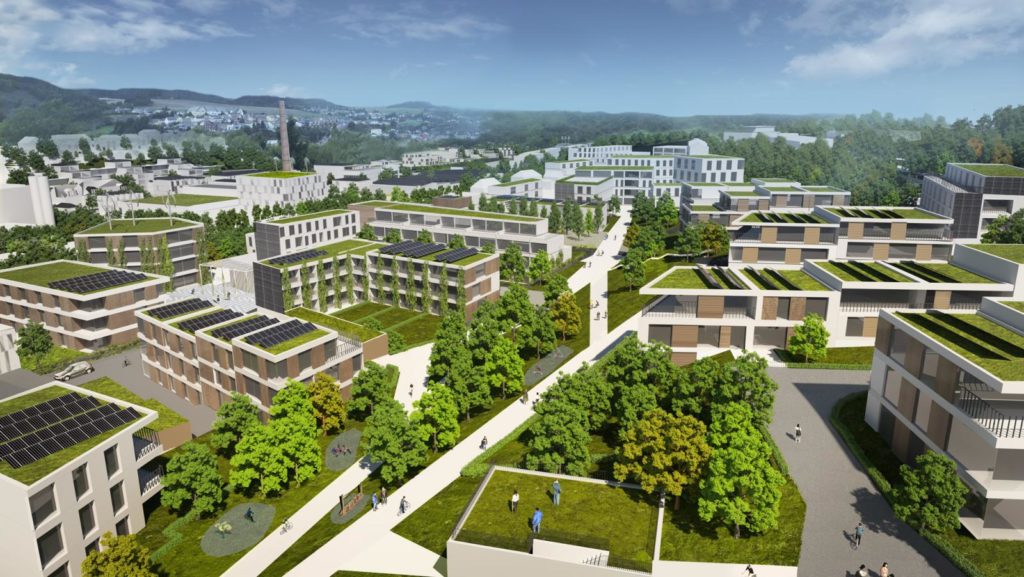
Model of the future district ‘Wunne mat der Wooltz’. Source: Fondsdulogement.lu

Objective

The plan envisages creating 1 000 new residential units in the new district. This will provide housing for 2 000 additional inhabitants and about 550 new jobs will be created in the new district. The 25.5 hectare project is a classic conversion as the site was previously industrial.

The new residential area will be integrated into the existing urban fabric. New green public spaces and public functions (i.e. schools) will not only be used by new residents. They shall also become points of attraction for the inhabitants of the surrounding districts. Additionally, the area will connect two neighbourhoods previously separated by the industrial site.

Time frame

The technical feasibility study was conducted between 2010 and 2011. The master plan was developed from 2013 to 2017 and construction started in 2018. The district will be finalised until 2030.

Implementation steps and processes

Since 1996, the municipality of Wiltz has underlined the potential to transform an der Wooltz into a new residential district. However, the city did not have the financial means to realise an independent development. In 2010, the state reviewed the city’s plan and contracted a technical preparatory study as well as an urban management plan as input for the local land-use plan. In the meantime, a concept for de-pollution was elaborated. From 2013 to 2017, a master plan detailing the construction was created with the cooperation of 19 public partners. The first civil works, namely tearing down the factory buildings and de-polluting the soil ran from 2014 to 2015. With the finalisation of the master plan in 2017, the planning stage was completed and the concept was presented to the public.

Development involved 19 public actors working closely together. The master plan is thus a result of thorough cooperation between different public representatives and fields of expertise (housing, environmental protection, commerce, etc.).

Model of the future district ‘Wunne mat der Wooltz’, view towards East. Source: Fondsdulogement.lu

Required resources

The costs amounted to EUR 2 300 000 for planning, demolition and de-pollution of the former industrial area.

Results

The planning and the preparatory works have been completed. Construction however will only start after the approval of the PAP (specific land use plans), which act as building permits. They were submitted for approval in late 2017 and approved in 2018. Since then, construction for developing the new district started.

Construction and assignment of units will be organised through Fonds du Logement, a public developer, guaranteeing a social mix of residents in the new district. Housing will be assigned conditional on low household income, or the number of children.

Experiences, success factors, risks

With units for 1 800 inhabitants, the city will be able to increase its population by 30%. The district does not only target residents currently living outside of the municipality. Key to success is to encourage also current residents to move to the new district, for instance by making the new housing units more attractive and comfortable than those currently available in the surrounding neighbourhoods.

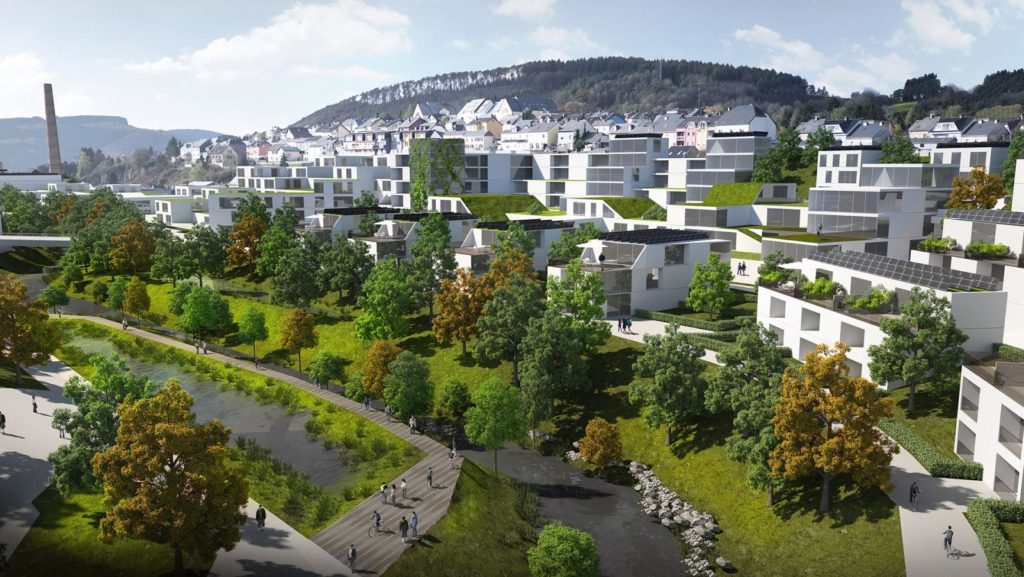
Model of the future district ‘Wunne mat der Wooltz’, view towards West. Source: Fondsdulogement.lu

Conclusions

Pressure on housing in Wiltz is less strong than in central or southern Luxembourg. Within the city and surrounding villages, the urban fabric could still absorb more new residents. The example of Wunne mat der Wooltz must be seen against very positive demographic and economic forecasts for the country in the upcoming years. At the same time, the government is pursuing a decentralisation policy, making regional centres more attractive. A significant increase in population and businesses in regional centres such as Wiltz, is envisaged.

The example follows the tradition of planning flagship projects in Luxembourg. Compared to other available areas in villages and cities, conversions could be a more general instrument of spatial planning and territorial development. So far, these urban developments are still exceptions not least because they are large and require significant finance. Providing a toolbox to municipalities could also give local administrations the opportunity to implement smaller conversion projects independently from the state. Collaboration across different levels in a small country such as Luxembourg risks local interests being strongly influenced by state objectives.

Model of the future southern district of the development ‘Wunne mat der Wooltz’. Source: Fondsdulogement.lu

Contact

Wiltz City Management: citymanagement@wiltz.lu 

Blog CIPU

Project presentation: ‘am Duerf’ a housing development project and a shared space in Dudelange

>

The urban development ‘am Duerf’ was inaugurated in 2017 to revive and increase the
attractiveness of an area next to Dudelange city centre. Development of housing, parking and commercial areas in an area previously used as open-air parking started in 2005. The
municipality of Dudelange has developed an adjacent shared space to create a lively urban area.

Rationale for action

‘am Duerf’ and development of the adjacent shared space was planned next to Dudelange city centre. The area was previously used as open-air parking and backyard gardens. The
transformation also helps the city to tackle the increasing housing need.

Tackling the housing shortage is a key priority on the political agenda in Luxembourg. By
constructing more housing units, the shortage of living space can be reduced and prices could drop. Some 13 000 new residents settle each year in Luxembourg overall, exceeding the annual supply of living space.

Larger cities, being the main centres of attraction, play an important role in accommodation. Housing developments within existing settlement structures and urban fabric can limit urban sprawl. Also, housing developments within urban centres provide the potential for densification and the development of vacant lots.

The project ‘am Duerf’ is also an attempt to counter the movement of urban functions to the periphery. By developing commercial functions, parking and housing in their centres, cities remain attractive. Restoration of public spaces also increases their attractiveness.

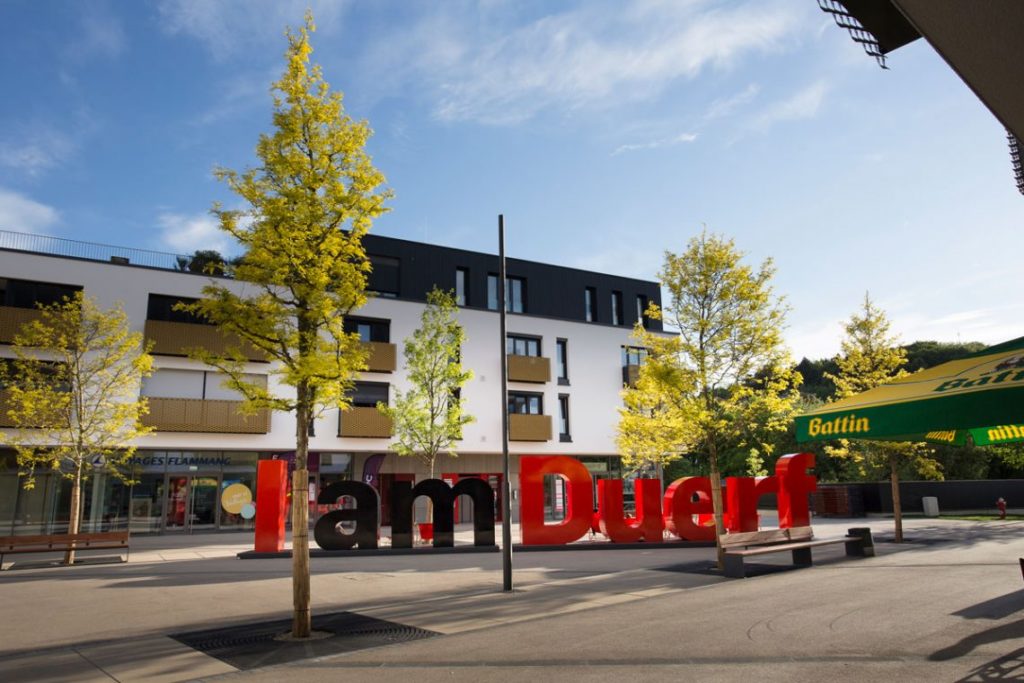
Central square of the project. Source: ondiraitlesud.lu

Objective

The ‘am Duerf’ project was designed to create an attractive new urban centre with parking, commerce and living spaces. Through these functions and the shared space, the amenities are not only for residents but also for inhabitants of surrounding areas.

The shared space was designed to overcome divisions between different modes of transport that could be troublesome. It combines pathways of individual, common and soft transport in a common zone with a focus on soft and public modes of transport. Breaking the divisions between different modes of transport increases the quality of the public space.

Time frame

The development ‘am Duerf’ was inaugurated in 2017. Building works to create the district started in 2014, the development of the shared space was started in 2016.

Key players

The key players are the City of Dudelange, with the Ministry of Housing and the Ministry Energy and Spatial Planning in supporting functions. The district was planned by the architect and urbanism bureau STEINMETZDEMEYER from Luxembourg. Private developers implemented the project.

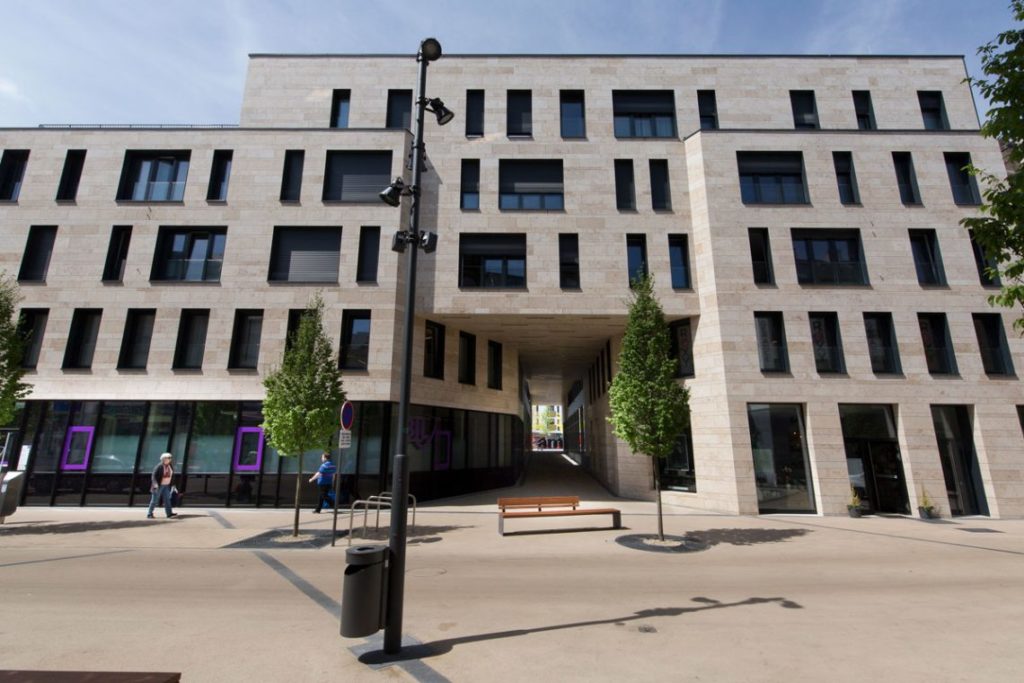
Architecture of the project. Source: ondiraitlesud.lu

Implementation steps and processes

The site of ‘am Duerf’ was owned by a private real estate developer who was also the project developer. Implementation began in 2005, when the idea came up to increase the city centre’s attractiveness by developing the area. An architectural competition was held in 2006. Development of the shared space is in three phases with the last due to be finalised in 2020.

Required resources

The total amount of urban development is unknown. The resources required to develop the shared space was EUR 3.5 million and the project was co-financed by the ERDF (European Regional Development Fund) through an Integrated Territorial Investment project for nearly EUR 1 million.

Results

The project ‘am Duerf’ resulted in three multi-functional buildings. Public spaces in between are used as crossroads for residents and inhabitants of the surrounding districts. A total of 104 apartments include studios, one to three bedroom-, two-story- and penthouse-apartments. Two apartments are rented as social housing. All units were built using state of the art principles to ensure maximum living quality and sustainability.

The design of ‘am Duerf’ places functionalities within the district on different levels. The
parking floor in the basement provides about 180 parking places very close to the city centre, as well as public and soft modes of transport. These are 70 more places than before, when the area was used as open-air parking. The ground floors provide 4 400 m2 of new commercial surfaces for a supermarket, hairdressers, cafés and more. Floors one to four are dedicated to apartments.

The adjacent shared space integrates this new district into the existing urban pattern. With
fewer barriers separating pedestrians, cyclists and vehicles, it invites interaction across streets, bridging barriers between old structures and new developments. The development has created a new public space in the centre of Dudelange using contemporary architecture and modern urban development planning.

Experiences, success factors, risks

Integrated planning enabled several functions to be combined in the new district including
new residences for new and former inhabitants as well as commercial surfaces. The preceding function of parking could even be extended. The vertical division of functions in the new district into parking, public space/commercial and residential areas help improving urban life and attractiveness. Separating functions on different floors allows their full development without getting in each other’s way. At the same time, the shared space enables a functional mix and social interaction that enlivens the district.

Conclusions

‘am Duerf’ and the shared space in Dudelange is an innovative urban development project. Following state of the art planning principles and modern urban architecture, the project improves the quality of life within and around the new district. This has led to a revival of the city centre, not least because of modern architecture and urban planning. In conclusion, ‘am Duerf’ and the shared space have contributed to changing the image of Dudelange’s city centre.

Contact

If you wish to receive further information, please contact Ms Eva Gottschalk, municipality of Dudelange: Eva.Gottschalk@dudelange.lu

Blog CIPU

A visit to ‘Elmen’, a new affordable housing district

>

On the 22nd of September 2020, CIPU organised a visit to ‘Elmen’, the largest affordable housing project in Luxembourg. The district is developed adjacent to the municipality of Kehlen in the West of Luxembourg (see here and map at the bottom).

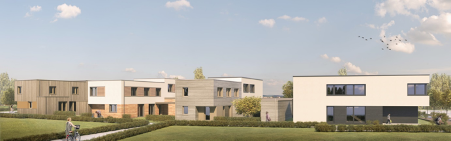
A 3D model of the houses being realised in ‘Elmen’. Source: S.N.H.B.M., 2020.

Elmen is developed by one of the public housing agencies of the country S.N.H.B.M. (Société Nationale des Habitations à Bon Marché, French for: National society for affordable housing). S.N.H.B.M. is a publicly owned institution which has been entrusted with the task of creating affordable housing throughout the country. It is one of the largest providers of affordable housing together with ‘Fonds du Logement’.

The projects realised by the two agencies differ in size and typology: some projects are comparably small and are constructed in the framework of renovating a building in a rural village centre. Some other projects are green- and brownfield developments and hence are larger in size (‘Fonds du Logement’ projects, S.N.H.B.M. projects). The affordable housing units created are either sold for a subsidised price or leased to tenants that are eligible to receive an affordable housing unit

All of the planned 750 – 800 units in Elmen will be sold as affordable housing units. Altogether, the planned apartment buildings and houses will be able to accommodate about 2,000 new residents. Households or persons that want to purchase a unit in Elmen need to fulfil a set of criteria. As an example, interested buyers have a higher chance of receiving a unit if they are a family with children already residing in the municipality of Kehlen with a household income below a certain threshold.

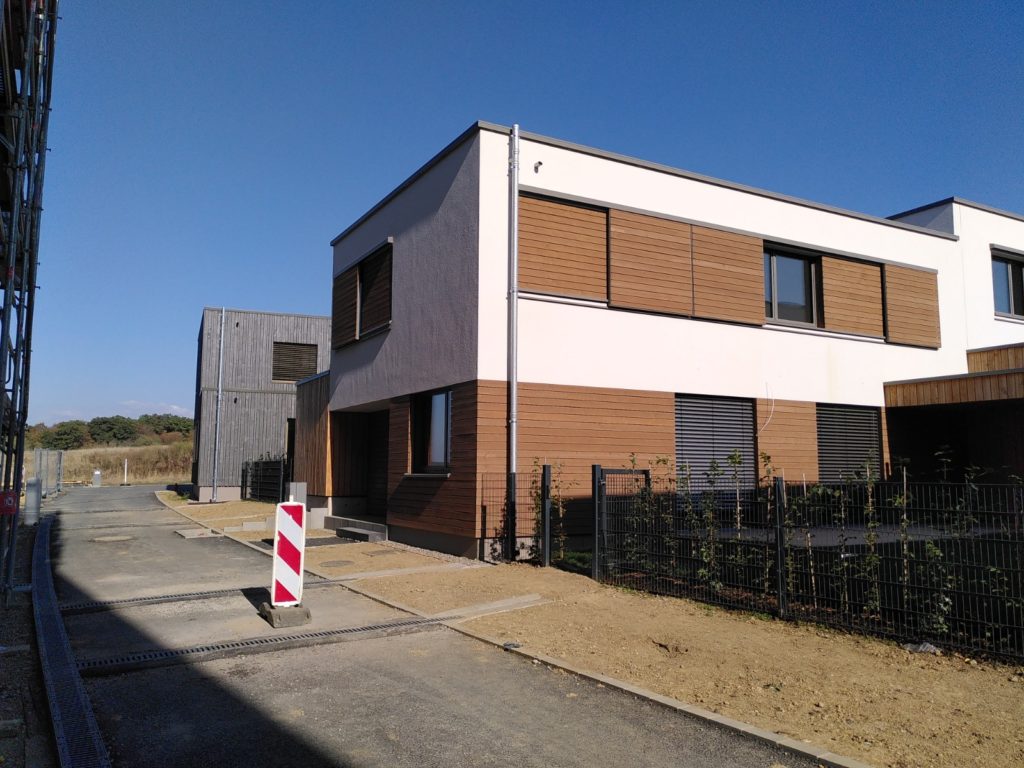
House alignment and street width in Elmen. Source: CIPU, 2020.

In order to use the 27 hectares greenfield as effectively as possible, Elmen was planned with a high population density. This contrasts the existing residential district in Kehlen. Once finalised, Elmen will feature a theoretical population density of 7,400 inhabitants per square kilometres which is rather high for a rural area of Luxembourg. To make the high density work and to create a nearly zero-energy and affordable housing district, architects and planners had to apply some non-standard but innovative approaches in the design of the district and buildings:

  1. Parking is organised centrally in car parks: this saves space and allows to limit street surfaces.
  2. Houses and residences are facing away from one another: this allows every homeowner to benefit from a small garden and some privacy.
  3. Wood is the primary construction material for houses: nine different typologies of individual houses are built, all from glued solid wood boards. During the planning, an emphasis was put on standardisation of building blocks, to allow for large-scale production and to limit costs.
  4. Houses will produce 50 % of the energy they consume: photovoltaic, heat-air pumps and a district heating and cooling network allow to reduce energy consumption of the district.
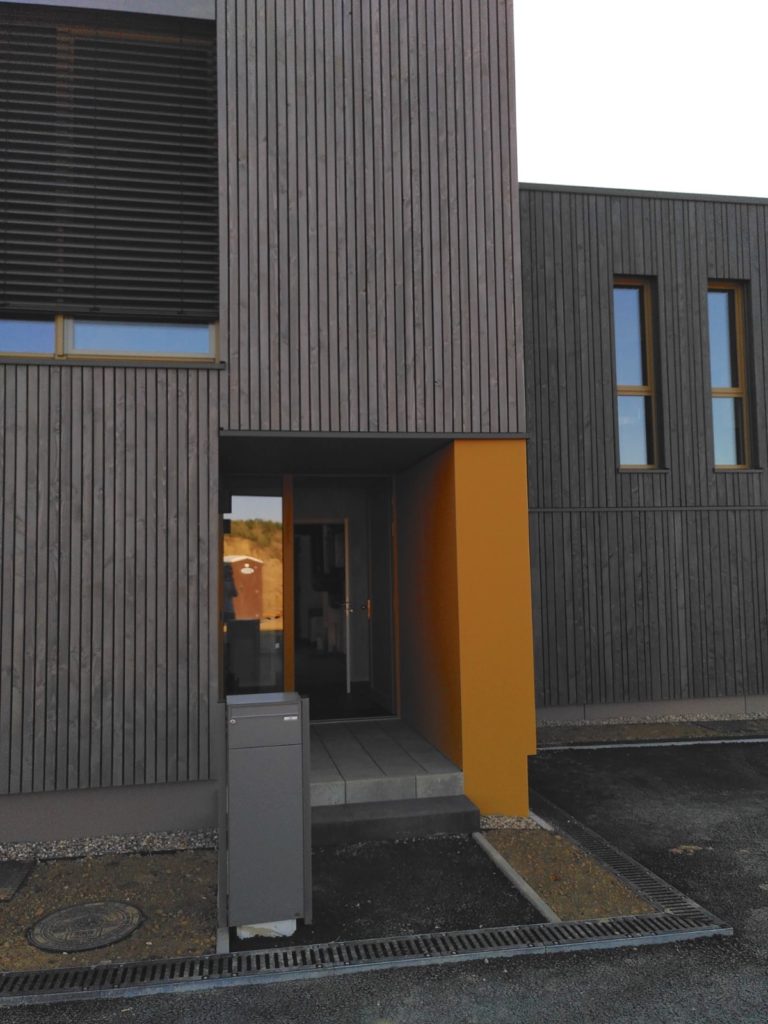
Entrance to one of the finalised single family houses. Source: CIPU, 2020.

The first set single-family houses have already been constructed. All single—family houses are spacious and well-equipped providing at least three bedrooms, an office, a living room, a kitchen and a small private garden.

To familiarise planners and architects with the project and the design choices, CIPU (National Information Unit for urban Policy) organised a guided tour through Elmen in autumn 2020. About 20 professionals from the sector participated in the tour and were given the chance to get to know the district as well as some of the already realised houses.

The density of the area is impressive; at first sight, houses are very close together, creating the impression of providing little private space. On second glance, this illusion crumbles: the houses are placed in a way that windows and exits do not face one another and gardens are seldom in view of the windows of a neighbouring house. This creates some private spaces for residents.

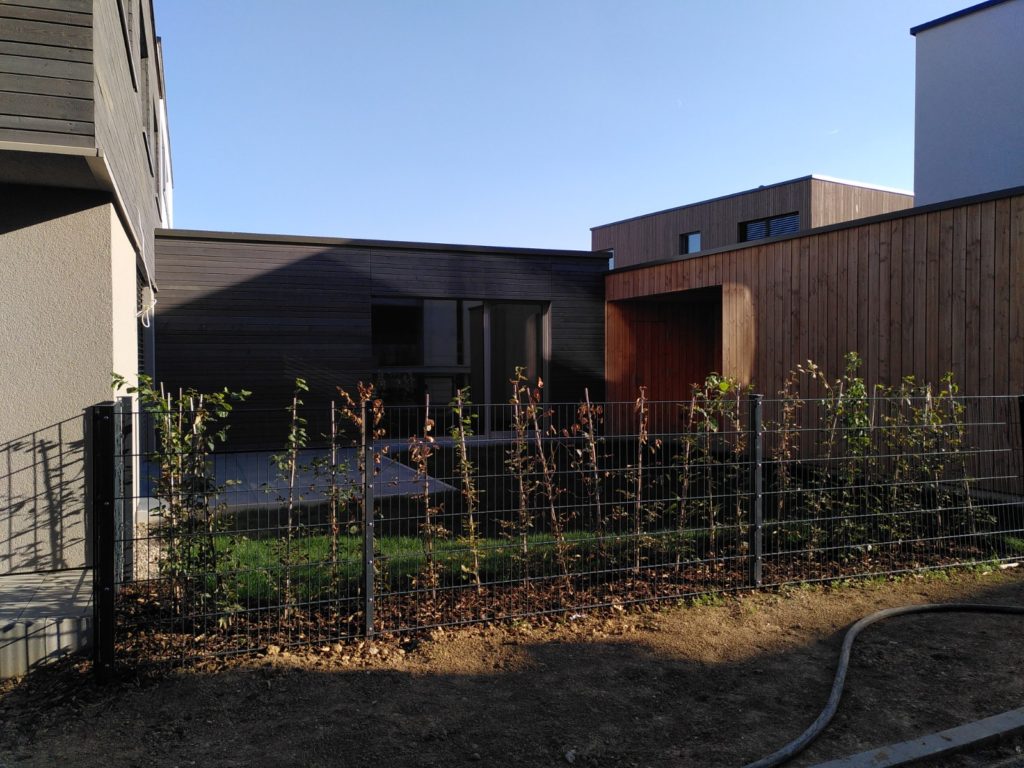
Private gardens in Elmen. Source: CIPU, 2020.

The centralised parking has enabled planners to reduce street width. Only access roads to the centralised car parks and the stations for public transport feature regular street width of more than four metres. All residential roads are much narrower so that a car can pass in one direction only. This renders the road network more pedestrian friendly. After all, roads in Elmen are not just intended for private transport but as places to meet for neighbours and residents.

Building alignment in the Elmen district. Source: CIPU, 2020.

And despite the high density, the area does not feel like an inner-city district. In Elmen, the urban environment conveys the impression to visitors to roam through a village-centre. For example, the building height of single-family units are limited to two stories, the apartment buildings don’t exceed three stories in height. Most windows and doors face the streets, allowing for social control. Additionally, all houses and small gardens are directly accessible from the street, leading to the fusion of private and public space.

So far about 10 houses were finalised and are used to promote sales of the upcoming housing units (about 740 to 790 units will be constructed). Elmen will be realised stepwise in three separate lots and will also provide a central supermarket as well as a primary school.

For more information about the concept of Elmen make sure to read our project sheet which can be accessed under the following link. Further information and a few more pictures are provided on the website of the project.

Location of the Elmen district within the Grand Duchy of Luxembourg. The yellow borders show the limits of lot 01. Source: CIPU, 2020.

In case of questions or comments, please feel free to contact the editor (sebastian.hans@spatialforesight.eu) of this article.


up to top