


How many childcare places will a municipality need in ten years? How can traffic calming measures be assessed before they are implemented? How can environmental constraints be integrated into development projects that extend across municipal boundaries? And how can citizens be meaningfully involved throughout these processes? These practical questions formed the starting point for CIPU’s first workshop of 2026 on data and digitalisation in urban and regional development. Bringing together representatives from municipalities, public administrations and planning practice, the workshop explored how data and digital tools can support better planning decisions and where the main obstacles still lie.
CIPU 2026: Data and Digitalisation
The Luxembourgish Exchange Platform for Urban Development (CIPU) has placed data and digitalisation in urban and regional development at the centre of its 2026 programme. Building on discussions from the annual Colloque 2026, this year’s activities examine how data can support sustainable and resilient planning decisions, improve forecasting and scenario-building, and make planning processes more transparent, participatory and efficient. The first workshop focused on a central question: what does digitalisation mean in everyday planning practice?
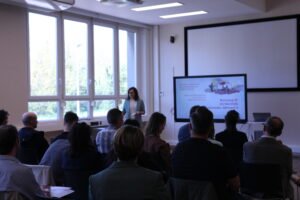
Workshop 01 – Digitalisation in Everyday Planning
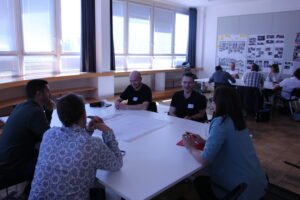
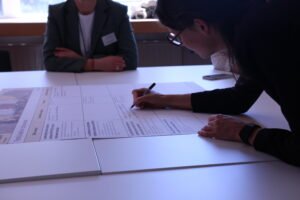
The workshop took place on 23 April 2026 in the Metzeschmelz quarter in Esch-sur-Alzette. Participants discussed challenges relating to the use of data and digital processes in planning, organised around four thematic areas drawn from everyday planning practice: demography, citizen participation, environment and mobility. Across these themes, they explored which data is available, where important gaps remain, what barriers limit its use, and how digital approaches could help overcome them. Despite the different planning contexts, the discussions revealed remarkably similar priorities and common directions for strengthening data-driven planning.
Six Common Challenges
The workshop identified six recurring challenges that currently limit the use of data and digital tools in planning processes.
- Scale and spatial resolution. Many publicly available datasets are collected at national or regional levels but are too coarse for local planning questions. Examples included demographic data that does not allow analysis at neighbourhood level and environmental datasets that lack the spatial precision needed for project-level decisions. Participants stressed that local planning often requires information at a much finer scale than currently available.
- Formats and data preparation. Data is often available but difficult to use in practice. Participants pointed out that traffic counts are frequently published only as PDF reports, preventing further analysis and integration into digital workflows. Similar issues arise when data is collected using different methodologies or standards across municipalities and sectors. The lack of harmonised formats, metadata and collection methods limits comparability and increases duplication of effort.
- Data gaps. Important datasets are often missing or not available in digital form, including information on vacant housing, childcare capacity, pedestrian and cycling movements, real-time traffic flows and neighbourhood-level development trends. These gaps limit evidence-based planning.
- Access barriers. In many cases, data already exists but cannot be used because access is restricted or unclear. Examples discussed included parking occupancy data held by private operators, traffic surveys commissioned by municipalities but not publicly available, and employment-related datasets that remain difficult to access despite their relevance for planning decisions.
- Uncertainty regarding data protection. Questions around data protection and GDPR continue to create uncertainty when sharing and using data. This affects areas such as mobility analysis, where origin-destination data may contain sensitive information, as well as citizen participation processes involving minors. Participants noted that municipalities often require clearer guidance and practical tools for handling sensitive data while remaining compliant with legal requirements.
- Resources and competences. Especially in smaller municipalities, limited staff resources and technical expertise can hinder the effective use of digital tools. The challenge is not only acquiring new technologies but also developing the skills, knowledge and organisational structures needed to use them effectively over time.
Directions for Solutions beyond Technology
The workshop highlighted that the main obstacles to digitalisation are not technological. Many of the necessary tools already exist. The greater challenge lies in ensuring that data is available, accessible, comparable and maintained over time.
Data governance emerged as a central issue. Data only creates value if it can be found, understood and reused. Shared standards, harmonised formats and reliable metadata are therefore as important as the data itself. This starts with considering how data will be used and combined already when it is collected, and ensuring that it is available in interoperable, machine-readable formats. Whether for mobility, environmental assessments, demographic projections or citizen participation, planning processes depend on data that is comparable across municipalities, sectors and administrative levels.
Accessibility and data sharing remain key bottlenecks. Many relevant datasets already exist but are difficult to access due to organisational, legal or contractual barriers. Clearer frameworks for data exchange would unlock significant potential while maintaining appropriate safeguards for sensitive information.
Municipalities also need sufficient resources, practical guidance and opportunities for knowledge exchange if digital tools are to become part of everyday planning practice. Training opportunities, shared services and accessible toolkits can help bridge existing capacity gaps.
Digital participation works best when combined with established analogue formats and adapted to different target groups and project phases. At the same time, many planning challenges extend beyond municipal boundaries, making stronger cooperation and interoperable data structures increasingly important.
Advancing digitalisation in planning is therefore less about developing new technologies and more about creating the institutional and organisational conditions that allow existing tools and data to be used effectively.
Digital Twins in Practice – Agora
Understanding complex spatial systems, testing alternative development scenarios and communicating planning proposals to different stakeholders are among the areas where digital tools can provide particular added value. Digital twins are one example of how data from different sources can be combined, visualised and analysed to support planning processes throughout their lifecycle – from understanding existing conditions to evaluating future development options and monitoring implementation. This perspective was illustrated through a presentation by Agora, which showcased how digital models and digital twins are being applied in Luxembourg. The examples demonstrated how such tools can support planners in analysing territories, facilitating communication between stakeholders and creating a more transparent basis for decision-making.

Outlook
The workshop showed that the potential of digitalisation for urban and regional planning is considerable. At the same time, realising this potential depends not only on technological innovation but also on data quality, governance, accessibility, organisational capacity and cooperation.
The six challenge areas identified during Workshop 1 will form the basis for the next stage of the CIPU programme. During the second workshop, participants will work on concrete application cases that explore how data and digital tools can address these challenges in everyday planning practice. The results will also contribute to the discussions at the annual CIPU conference later this year. A detailed documentation of the annual results will be published on the CIPU website at the end of the year.
Contact and Further Information
CIPU – Cellule nationale d’Information pour la Politique Urbaine: https://cipu.lu
Contact: cipu@zeyenbaumann.lu
