


“I’m Kaya,” says the local restaurant owner, jumping into the conversation and tapping the map with a finger. “If there’s no table outside, nobody even notices the place. If the street in front is loud, nobody stays longer than five minutes. And if a centre doesn’t pull people in, they won’t stop for a coffee, won’t meet anyone, won’t come back. Without people, a district centre simply fails.”
Across from her, Misch clears his throat. Primary school teacher. “That’s exactly why it has to work for families first. If everyday needs aren’t built in, families disappear. Children need protected spaces, parents need routines they can trust. Without that, there is no daily life here. And without daily life, nobody will be there to have a coffee.”
Jamie, 17 years old, apprentice, leans back on the chair. “I’m not here to spend any money. I just want somewhere close by where I can hang out with my friends after school and not be in the way.”
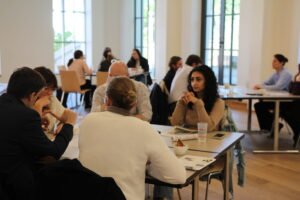 Group discussion in the public participation process about the culture and leisure district of Duffereschbourg 2045 (source: CIPU)
The map between them shows the culture and leisure district of Duffereschbourg – the 15-minute-city in Luxembourg 2045. The discussion circles around a shared perspective: how this neighbourhood should function in twenty years’ time, if everyday life is to happen close by. During the public participation process, similar discussions took place in parallel in other groups, aiming at surfacing different perspectives and feeding them into the design of the neighbourhood.
Phase 1: Walking the future
In the morning, the citizens of Duffereschbourg 2045 split into small groups – each group with a different assignment for the participation process: redesign a building complex, rethink a public square, invent a quartier hub, develop a tiers-lieu – an open, non-commercial space of everyday life. All aligned with the concept of the 15-minute-city.
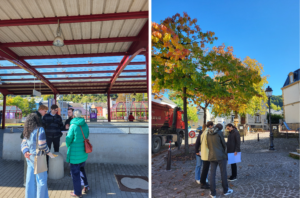
Working phase 1 (source: CIPU)
They introduce themselves, read their assignment, then they go outside. They walk across five locations in the district. At every spot they stop – look – argue. Is this place right? Too loud? Too hidden? Perfect at noon, useless at night? How can you access it? Where could the next supermarket be located? What do I expect from the place? What will people living here in 20 years need?
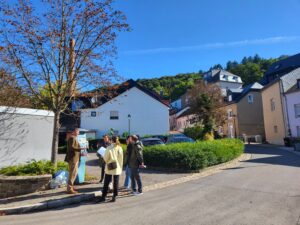
Interruption from the future (source: CIPU)
And then the future interrupts. Elvan Malik, time traveller from Duffereschbourg 2045 appears. He speaks of public space as a “resonance room” – not controlled by cameras, but shaped by rhythm, behaviour, proximity. Not every place for everyone, but everyone entitled to a place. New questions emerge. Does our proposal still make sense like this? By the end of Phase 1, each group has chosen a location and worked out a concrete proposal: functions, users, atmosphere, conflicts included.
Phase 2: Putting it together
After lunch, the groups reshuffle. Now the restaurant owner sits with other local businesses, the teacher with street workers, planners with urbanists, decision-makers with public sector representatives. Each explains what their first group designed. Then comes the difficult part: comparison and compromise.
Same places chosen twice – for different purposes. Ideas that fit neatly together, like the concept of the tiers-lieu complementing the new district hub and mobility solutions that compete for the same parcel. Questions of access, noise, opening hours, care, control.
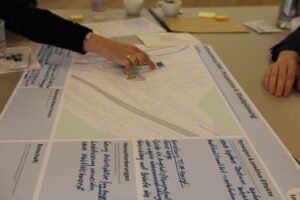
Comparison and compromise (source: CIPU)
Slowly, the district takes shape on four shared maps each showing a different but plausible way of approaching and implementing the same concept. The citizens of Duffereschbourg gather around the drafts, comparing sketches, pointing to routes, tracing overlaps and tensions. The district does not settle into one clear approach, but into a shared understanding of what matters – and what still needs to be negotiated.
Behind the scenes
In October, CIPU organised a full-day role play planning simulation (Planspiel) as part of its thematic year on the 15-minute city – urban proximity – everyday urbanity. The event was designed as a fictional public participation process. Participants were assigned detailed role profiles, including professions, socio-economic backgrounds and value orientations. After a joint introduction to the holistic concept of the 15-minute-city, they were invited to step into the year 2045 and take part in the planning of the Grevenlach district of the fictious city Duffereschbourg.
The process followed a clear structure. In Phase 1, participants worked in task-based groups on four concrete assignments: redesigning a building complex, transforming a public square, developing a quartier hub and conceiving a tiers-lieu. In Phase 2, these proposals were brought together in sector-based groups, discussed, compared and synthesised. The result was four distinct maps for Grevenlach, each representing a different approach to implementing the principles of the 15-minute-city for the culture and sport district.
Across the groups, similar observations emerged. Like re-thinking mobility and short-term, temporary or pop-up solutions were often identified as realistic entry points to try things out and get critical minds on board. At the same time, many participants noted how challenging it is to think unconventionally about their and next generations’ future needs while remaining anchored in everyday realities. The exercise made clear that urban proximity is less about fixed models and more about continuous negotiation.
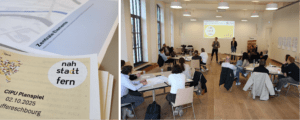
An inspiring planning simulation (source: CIPU)
The day made urban proximity tangible by letting participants slip into other people’s shoes and argue from unfamiliar perspectives. It highlighted the importance of participation in shaping proximity in neighbourhoods: understanding actual needs and arguments, making trade-offs visible and finding compromises between competing interests.
Building on the insights from the Planspiel and the other CIPU activities in 2025, such as the online colloque, workshop 1 and 2, a toolbox on the 15-minute-city was developed. It was presented at the CIPU annual conference, which has since taken place. A dedicated blog post reporting about the conference and introducing the toolbox will follow shortly.
Contact & further information
CIPU: https://cipu.lu/
CIPU contact: cipu@zeyenbaumann.lu
