


Early each morning, trains and motorways from Thionville, Trier, Arlon and towns across the Greater Region fill with people travelling to work in Luxembourg. In the evening, these flows reverse. These daily journeys link places across four countries – not only through employment and transport, but also through housing.
In 2024, cross-border workers accounted for around 43% of Luxembourg’s workforce. In some municipalities close to the border, up to 55% of the working-age population commutes to Luxembourg. Together, these daily journeys create a functional region in which employment, transport and housing are closely interconnected – and where national housing statistics show only part of the picture. Housing searches cross national borders, while housing policies and planning instruments remain organised mainly within national and regional systems.
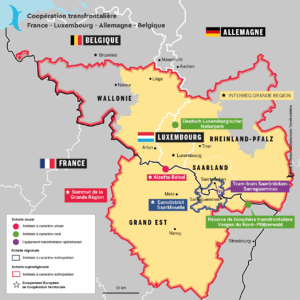
Map of the Greater Region by mot – Mission Opérationelle Transfrontalière (source: https://www.espaces-transfrontaliers.org/cartes/le-territoire-de-la-grande-region/)
How economic growth extends the housing market
Luxembourg’s cross-border housing market is closely linked to its economic development. Employment and economic activity remain concentrated within the country, while a substantial part of the workforce lives in the surrounding regions. Housing demand therefore extends beyond Luxembourg’s borders alongside the labour market.
The LISER research project CRoss-border mobility, HOUSing market developments, and IneQualities (CRHOUSINQ) examines these connections between economic growth, commuting, residential relocation and housing-market developments. It considers Luxembourg and the Greater Region as an example of a dynamic economic centre whose labour and housing markets extend beyond its administrative boundaries.
This creates opportunities as well as distributional questions. Living outside Luxembourg may provide access to more space or lower housing prices for people employed in the country. At the same time, households earning Luxembourg salaries and those relying on local wages may enter the same housing market with considerably different purchasing power.
How economic growth extends the housing market
The Luxembourg case study of the ESPON project HOUSE4ALL on access to affordable and quality housing, Cross-Border Housing Markets – The Case of Luxembourg, examines how housing costs and affordability vary across this functional region. It combines housing offers collected between March 2024 and March 2025 with local income data for Luxembourg and neighbouring parts of France, Germany and Belgium.
The price differences are considerable. According to the study, purchasing a home in Luxembourg is, on average, around three times as expensive as in the neighbouring regions. Average rents are approximately twice as high. These differences help explain why households working in Luxembourg may consider homes across the border, although housing costs are only one factor in residential decisions.
These differences also matter for people already living in Luxembourg, including Luxembourg nationals. An analysis by Luxembourg’s General Inspectorate of Social Security (2023) records 3,647 workers who moved abroad in 2022 while continuing to work in Luxembourg; nearly 90% moved to the Greater Region, and 30% held Luxembourg nationality. Research by the Center for Border Studies at the University of the Greater Region, drawing on interviews conducted between 2022 and 2024, identifies high housing costs and the search for more space as important reasons for relocating to neighbouring France.
Price alone, however, does not provide a complete picture. Incomes also differ significantly. To compare purchasing power, the study calculates how many square metres a person could theoretically buy or rent by spending one-third of an average income on housing. This shows that differences in rental affordability are smaller when local wages are taken into account. At the same time, people earning a Luxembourg income generally retain substantially greater purchasing power in neighbouring housing markets than residents working locally.
This indicator captures the relationship between housing prices and incomes, but not the full cost or attractiveness of a residential location. Commuting time, transport costs and accessibility also matter, as do the number of earners in a household and where they work. Personal preferences and culturally shaped expectations about space, housing type and outdoor areas further influence which homes households consider suitable. Housing decisions in the Greater Region therefore involve balancing financial means, everyday travel and expectations of a home.
Different dynamics along the three borders
The spatial patterns identified by HOUSE4ALL are not distributed evenly across the Greater Region. They appear particularly pronounced along the French border. Higher housing costs and lower affordability for locally employed residents are particularly visible in areas close to Luxembourg and along the Moselle transport corridor. The HOUSE4ALL study finds that the rental market is especially affected. In parts of the French border region, people earning a local income can afford less rental space than people living and working in Luxembourg at a comparable distance from Luxembourg City.
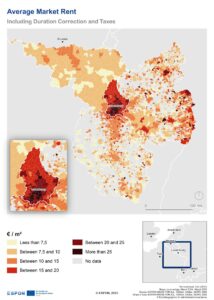
Average advertised rents across Luxembourg and neighbouring regions (source: ESPON HOUSE4ALL (2025), Map 2, p. 20: https://www.espon.eu/publications/house4all-crossborder-housing-markets-luxembourg)
The German border presents a more differentiated picture. Higher prices and lower affordability are visible around Trier and in the southern border area, which is well connected to Luxembourg City. Further north, the market is more rural, housing offers are fewer and the influence of Luxembourg appears weaker.
Along the Belgian border, the overall effect is less pronounced. Wallonia has a comparatively homogeneous price structure, although Arlon and Bastogne stand out as areas where Luxembourg’s influence is more visible.
These patterns suggest that proximity to the border is not the only relevant factor. Accessibility also appears to matter. Many of the areas with lower affordability are directly connected to Luxembourg City by major transport corridors. The functional housing region therefore follows commuting routes as much as administrative boundaries.
A cross-border market, national policy systems
These housing dynamics increasingly operate across borders, while the main instruments for planning, housing provision and affordability remain organised nationally or regionally. Luxembourg and its neighbours already cooperate through the institutions of the Greater Region, Interreg programmes, municipal networks and cross-border transport initiatives. In housing, however, definitions of affordable and social housing differ, planning instruments follow separate legal frameworks, and comparable local data remain difficult to assemble.
The HOUSE4ALL analysis is a step towards a more integrated evidence base, but it also highlights remaining gaps. The housing data cover only one year, while the local income figures include commuters and may therefore overstate the purchasing power of residents working exclusively in the neighbouring regions. The affordability indicator also does not account for commuting time or transport costs. Longer-term, harmonised data combining housing, income and accessibility could help distinguish temporary market developments from structural cross-border trends and provide a fuller picture of residential choices. Beyond measurable differences in housing costs, incomes and accessibility, these developments also affect how residents experience and perceive change in their communities – a dimension that deserves further attention when considering the wider implications of cross-border housing dynamics.
The available evidence nevertheless points to an increasingly interconnected space of employment, residence and daily mobility. Recognising this functional geography can help municipalities, planners and policymakers monitor housing demand, understand differences between well-connected border areas and consider where closer coordination or shared evidence may be useful. The housing market already crosses the border. The next step is to improve the shared evidence needed to understand it – and to identify where coordination between existing national and regional systems can add value.
Sources and further reading
LISER (2022-2025): CRoss-border mobility, HOUSing market developments, and IneQualities (CRHOUSINQ) (EN)
ESPON (2023-2025): HOUSE4ALL (EN)
ESPON (2025): HOUSE4ALL: Cross-Border Housing Markets – The Case of Luxembourg (EN)
Inspection générale de la sécurité sociale (2023): Les Frontaliers Atypiques – Passer de travailleur résident à travailleur frontalier : les contours d’un phénomène grandissant
University of the Greater Region – Center for Border Studies (2025): Grenzüberschreitende Ungleichheiten in der Großregion (DE, FR, EN)
LISER (2024): Attitudes towards Immigration in a Highly Multicultural Society: The Roles of Foreign Background and Local Exposure (EN)
