


With a population of just over 660.000, Luxembourg is one of Europe’s smallest states – yet its functional territory extends far beyond its borders. Around 230,000 workers commute into the country daily from France, Belgium and Germany, making up nearly half of the entire workforce. Housing markets, transport networks, healthcare facilities and labour markets do not stop at national borders. Recognising these interdependencies, cross-border cooperation has become an integral part of Luxembourg’s territorial development approach.
A country linked to its neighbours
Luxembourg shares a total of roughly 360 kilometres of border with three countries. This geography has shaped strong functional relationships with neighbouring territories and encourages close cooperation across a wide range of policy areas. Municipalities on the French side of the Alzette valley are closely connected to Esch-sur-Alzette and the wider Southern Region. Similarly, communities in the Belgian Ardennes are linked to Luxembourg’s northern regions through labour markets and public services. Along the Moselle, villages in the German state of Rhineland-Palatinate and Luxembourg have shared economic and cultural ties for centuries.
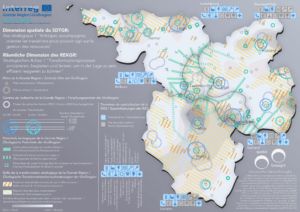
Spatial dimension of the Territorial Development Plan for the Greater Region – SDTGR (source: https://www.sig-gr.eu/fr/cartes-thematiques/amenagement-territoire/schema-developpement-territorial-gr/Representation_cartographique_axes_strategiques_2021/axe_strategique_1.html)
This is not simply a matter of commuting flows. Housing demand in Luxembourg has crossed borders and reshaped land use in adjacent French, Belgian and German municipalities. Investment in infrastructure on one side of the border generates demand – or congestion – on the other. Climate and biodiversity challenges in river valleys and nature parks require management strategies that no single national or regional administration can deliver alone.
Luxembourg’s national spatial planning framework, the Programme Directeur d’Aménagement du Territoire (PDAT), explicitly recognises these interdependencies and defines cross-border action areas as an integral component of the country’s territorial development strategy.
From strategy to action
The Interreg VI Grande Région programme provides an important instrument for translating this strategic vision into funded action, covering the 2021–2027 programming period. Covering Luxembourg and its neighbouring regions – Wallonia and the German-speaking Community of Belgium, the Grand Est region of France, and the German states of Rhineland-Palatinate and Saarland – the programme is supported by almost €182 million of the European Regional Development Fund (ERDF).
Within the programme, the instrument of a “cross-border functional area” is specifically designed for the kind of integrated, locally grounded cooperation that Luxembourg’s geography demands. Approximately €47 million – more than a quarter of the programme’s ERDF budget – is allocated to nine functional areas across the programme area. Luxembourg participates in seven of these zones.
Unlike traditional cooperation projects, a functional area requires three conditions, so governance accountability and project delivery are built in from the outset. To be eligible it must have:
- a clearly defined cross-border territory;
- an integrated, multi-sectoral strategy developed with local stakeholders;
- a formal governance structure capable of accompanying the implementation of the strategy.
Following the formalisation of the last three zones between December 2024 and March 2025, all nine zones are operational across the programme area.
Seven zones in practice
The seven zones in which Luxembourg participates closely align with the cross-border action areas of the PDAT, as well as the proximity territories defined in the Schéma de Développement Territorial de la Grande Région (SDTGR), the shared territorial reference framework for the entire Grande Région.
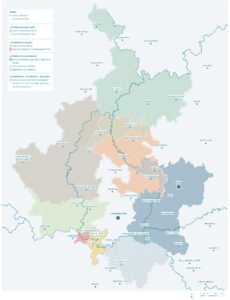
The functional areas of Luxembourg (source: https://amenagement-territoire.public.lu/fr/grande-region-affaires-transfrontalieres/zones-fonctionnelles.html)
The Upper Moselle Valley – Entwicklungskonzept Oberes Moseltal (EOM)
The Moselle valley between Trier/Grevenmacher and Schengen/Perl has long been shaped by a shared wine culture, tourism economy, and settlement history that crosses the German-Luxembourgish border. The EOM functional area translates this into a coordinated planning approach, bringing together the spatial planning ministries of Luxembourg, Rhineland-Palatinate, and Saarland alongside LEADER action groups and local actors. With €6.8 million ERDF, two examples are Brückenschlag DeLux, which assesses a new pedestrian and cycle connection between Nittel and Machtum, and AquaPilot, Partial automation of the Oberbillig–Wasserbillig electric ferry, with the aim of achieving full automation in the long term More at www.eom-dl.eu
The Alzette agglomeration – EGTC Alzette–Belval
The agglomeration straddling the Franco-Luxembourgish border in the south – Esch-sur-Alzette on the Luxembourg side, and municipalities including Villerupt, Audun-le-Tiche, and Russange on the French side – is one of the most intensively integrated urban areas in the Grande Région. The EGTC Alzette–Belval functional area builds on the European Grouping of Territorial Cooperation of the same name, with a joint decision-making committee including Luxembourg and French state authorities, municipalities on both sides, and regional bodies. With €5.5 million ERDF, two examples are ACTE, which involves residents in the ecological transition of the agglomeration, and ABURCO, which brings planners and public authorities together to coordinate urban development and monitor change across the border. More at https://zf-interreg.gectalzettebelval.eu/
The north-western border – Zone fonctionnelle Luxembourg–Wallonie Nord
The Luxembourg-Wallonie Nord cross-border functional area addresses cross-border development between Luxembourg’s north-western territories and the municipalities of the Belgian Ardennes, with a thematic framework covering urban development, public services, mobility, climate adaptation, water management, biodiversity, circular economy, and tourism. It is managed by Idelux, the Belgian intermunicipal development agency, with a budget of €5.1 million ERDF. Two current projects show this range: DSENS links Park Sënnesräich in Wincrange with Houtopia in Houffalize through a shared sensory-tourism offer, while Voies d’Eau-trefois connects four nature parks to interpret and improve access to water-related and industrial heritage, including the unfinished Bernistap canal. More at https://www.idelux.be/fr/les-zones-fonctionnelles-transfrontalieres-zft-luxembourg-wallonie
The south-western border – Zone fonctionnelle Luxembourg–Wallonie Sud
The Luxembourg-Wallonie Sud cross-border functional area covers the more urbanised interface around Arlon and the south-western territories of Luxembourg, sharing the same thematic framework and managing structure as the Nord zone. Its ERDF budget is €4.1 million. Two examples focus on everyday cross-border services: Barnich-Kleinbettingen is creating a safe walking and cycling connection from Autelbas-Barnich and Sterpenich to Kleinbettingen station, while WALUXSANTÉ is working to improve cross-border access to healthcare and strengthen training and cooperation among healthcare providers. More at https://www.idelux.be/fr/les-zones-fonctionnelles-transfrontalieres-zft-luxembourg-wallonie
The northern trinational area – Trinationale Region Eifel–Ostbelgien–Éislek (EOE)
Ostbelgien, Luxembourg’s Éislek, and the German Eifel share a common upland landscape and a long history of cross-border cooperation. In December 2024, this cooperation was formalised through the creation of a European Economic Interest Grouping (EEIG) as the zone’s managing structure. With €4.2 million ERDF and a rolling project call open since April 2025, the zone covers tourism and culture, nature, mobility, labour market, public services, and energy. Two current Interreg projects illustrate these priorities: the project Denk mal an Europa! is redeveloping the Europe Monument at the Belgium–Germany–Luxembourg tripoint as an accessible place for learning and exchange More at www.fr-eoe.eu
The river valleys – Mëllerdall–Our–Südeifel functional area (MOSE)
The MOSE zone covers the predominantly rural landscape of the Our and Sauer river valleys along the Luxembourg-German border, encompassing 21 municipalities in Luxembourg and 106 Ortsgemeinden across four Verbandsgemeinden in Rhineland-Palatinate. The zone is managed by an existing cross-border local association and builds on the nature parks of this region. With €4.01 million ERDF, its strategy focuses on nature and environment, ecological footprint, transport and mobility, regional identity, and quality of life. The area’s first published project, Grenzenlos – Naturparke im Dialog, is creating a shared platform for education and exchange on sustainable regional development among the Südeifel, Our, and Mëllerdall nature parks. More at www.mose-fr.eu
The Chiers and Alzette rivers – Territoire naturel transfrontalier de la Chiers et de l’Alzette (TNT)
The TNT became officially active on 15 January 2025 as a functional area, covering the City of Differdange in Luxembourg and a small cluster of French municipalities – Herserange, Hussigny-Godbrange, Haucourt-Moulaine, and Saulnes – in a post-industrial river landscape shaped by the former steel industry. With €2.6 million ERDF managed by TNT asbl, the zone focuses on environment and natural resources, mobility and infrastructure, cultural heritage, and cultural tourism. Its first funded project, Rivières, approved in February 2026, develops the Chiers and Alzette watercourses as shared environmental and heritage assets. More at www.tnt-chiers-alzette.eu
Territorial planning through cooperation
Luxembourg’s participation in seven of the nine functional zones demonstrates the country’s long-standing acknowledgement that successful territorial development necessitates collaboration across national borders. Labour markets, housing, mobility, nature protection and public services all operate on a cross-border scale, and the cross-border functional area framework provides a specific tool and funding to address these issues collectively on a local level. With project pipelines now active across all seven zones, Luxembourg and its neighbours are well placed to translate this cooperative approach into tangible benefits for residents of one of Europe’s most interconnected border regions.
Contact and Further Information
Luxembourg functional areas: https://amenagement-territoire.public.lu/fr/grande-region-affaires-transfrontalieres/zones-fonctionnelles.html
Interreg VI Grande Région – functional areas: www.interreg-gr.eu/de/finanzierung/funktionale-raume
EOM: www.eom-dl.eu
GECT Alzette–Belval: https://zf-interreg.gectalzettebelval.eu/
Luxembourg–Wallonie (Nord & Sud): https://www.idelux.be/fr/les-zones-fonctionnelles-transfrontalieres-zft-luxembourg-wallonie
EOE: www.fr-eoe.eu
MOSE: www.mose-fr.eu
TNT: www.tnt-chiers-alzette.eu
PDAT: https://amenagement-territoire.public.lu/fr/strategies-territoriales/programme-directeur.html
SDTGR: https://amenagement-territoire.public.lu/fr/grande-region-affaires-transfrontalieres/SDT-GR.html
Contact CIPU: cipu@zeyenbaumann.lu
