


CIPU 2025 – Urban proximity as a planning task
The 15-minute city suggests ease: schools nearby, daily errands within walking distance, neighbourhoods that function as part of everyday life. Yet as discussions unfolded at the Journée de la politique urbaine in December 2025 – across political debate, expert input and municipal practice – it became clear that proximity depends on more than distance alone. It requires coordinated planning, negotiation across sectors and an understanding of neighbourhoods as interconnected systems, and getting residents on board. These questions had shaped the CIPU’s work throughout 2025 and came together in one place at the close of the year. Let us take you through the last CIPU year.
Working with proximity over a year
In 2025, the CIPU ran under the topic of the “15-minute-city – urban proximity and everyday urbanity”. Over the course of the year, the discussion evolved step by step – from clarifying concepts to examining how proximity is planned, negotiated and implemented in practice. The 15-minute city served as a common reference to structure this process and to make everyday needs reflected in spatial planning in Luxembourg’s cities.

Steps of CIPU events 2025 (source: CIPU)
Knowledge
At the beginning of the year, the emphasis lay on clarifying what urban proximity means and how it can be used as a planning tool. This discussion unfolded early on through the CIPU Colloque, a series of thematic online lectures held between February and March 2025. Contributions from international research and practice showed that proximity links mobility, access to services, health, social equity and governance, and therefore requires holistic planning. Research highlighted how short distances can support everyday routines and well-being, while also pointing to questions of spatial distribution and functional balance.
Fiction
Building on this knowledge basis, the process then shifted into an exploratory mode – how can the concept be approached in Luxembourg? Participants, professionals and experts of urban development, spatial planning and policy, were invited to work with the fictive city of Duffereschbourg in 2045 and to examine how proximity could structure everyday life at neighbourhood level in the first CIPU workshop in May 2025. Discussions centred on access to services, shared spaces, mobility, local identity and social interaction.

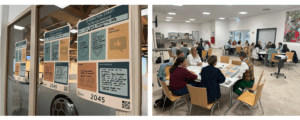
Impressions from workshop 1 (source: CIPU)
As ideas developed, several tensions became visible. Dense infrastructure met the need for open and green spaces. Flexible and temporary uses met long-term, stable planning. New functions encountered existing neighbourhoods. These discussions showcased the characteristics of planning for proximity.
Reality
When the discussion returned to Duffereschbourg a few weeks later in the second workshop, the focus shifted towards implementation. Earlier visions were translated into neighbourhood concepts and discussed in relation to concrete conditions such as available space, financial feasibility, administrative procedures and acceptance by residents.
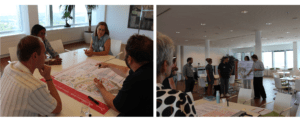
Impressions from workshop 2 (source: CIPU)
Questions of sequencing and governance moved to the foreground. Temporary uses, pilot and test projects were identified as important approaches to implementing the concept of the 15-minute city and building support. Cooperation between administration, politics, private actors and residents emerged as a recurring theme, as did the need for adaptable planning instruments.
Simulation
In October, the process shifted again, this time from discussion to experience. Through a role-based planning simulation conducted in Dommeldange, acting as Duffereschbourg, participants took on different perspectives and developed a concrete district. They experienced outdoor urban proximity and their own proposals developed in the workshops. They were often reconsidered when viewed through political, administrative or civic roles.
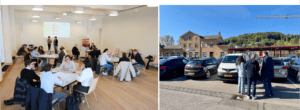
Impressions from the role play planning simulation (source: CIPU)
The exercise made clear how proximity is shaped through negotiation: between interests and demands, uses and time horizons. It also highlighted the role of participation in revealing conflicts and making trade-offs explicit.
Activation
The Journée de la politique urbaine in December brought the year’s work into a political and strategic context. The conference opened with a political discussion round bringing together representatives from the national level and the CIPU partner cities. Participants included Claude Meisch (Minister of Housing and Spatial Planning), Frank Goeders (Ministry of Home Affairs), as well as elected representatives from Dudelange, Differdange and Esch-sur-Alzette.
The discussion addressed how the idea of urban proximity is perceived and applied from a political perspective. Topics included the role of municipalities in strengthening everyday accessibility, the relevance of short distances for social cohesion and quality of life, and the limits of the concept in a context marked by commuting patterns and regional interdependencies. The exchange made clear that proximity is politically attractive as a guiding principle, while its implementation depends on long-term coordination across policy levels and sectors.
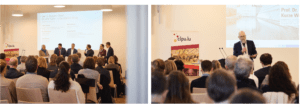
Impressions form the Journée de la politique urbaine (source: CIPU)
This political framing was complemented by expert inputs. Prof. Dr. Stefan Gärtner (IAT) examined questions of use and access, focusing on who benefits from short distances and where inequalities can persist. Zahira Malyani (AGORA) illustrated how neighbourhood programming can support urban proximity in concrete development contexts, drawing on the examples of Belval and Metzeschmelz.
In a final block, the perspective shifted to municipal practice. Contributions from the CIPU partner cities showed how proximity is already addressed through different approaches, including tiers-lieux, participatory democracy, temporary play streets, and the use of digital tools in urban development. An interactive exchange with participants highlighted active mobility infrastructure as a shared priority for strengthening proximity at neighbourhood level. These discussions took place during the conference held on 9 December 2025 at the Drescherhaus in Dommeldange.
Bringing the year’s insights together: the 15-minute city toolbox
The conference also served as the setting for presenting the CIPU documentation: a toolbox on the 15-minute city. Developed on the basis of the colloque, the two workshops and the planning simulation, the documentation consolidates the year’s discussions and results. Structured around six identified themes – community and liveable neighbourhoods, healthy living conditions, participation, proximity, local services and multifunctional space – the toolbox provides orientation for municipalities seeking to reflect on urban proximity in their own contexts and planning processes.
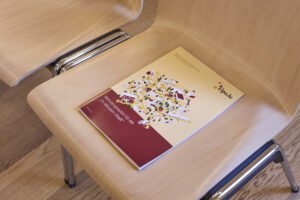
The CIPU documentation – a toolbox for the 15-minute-city (source: CIPU)
It shows that urban proximity takes shape most clearly at neighbourhood level. Everyday settings – schools, public spaces, local services, workplaces and meeting places – gain impact when they are planned in relation to each other and combined within short distances. Across the examples brought together in the toolbox, proximity emerges through multifunctional approaches: shared spaces, flexible uses and overlapping functions that reinforce daily routines and social interaction. Many municipalities in Luxembourg are already working along these lines, often through pragmatic, incremental steps. Bringing these approaches together highlights how existing projects can contribute to the 15-minute city without requiring a single overarching model. Looking ahead, strengthening proximity depends on better coordination between initiatives, planning instruments that allow for flexibility, and continued exchange across municipal and national levels, supported by data where it adds clarity to local decision-making.
The CIPU year 2025 approached urban proximity as an ongoing planning task, shaped by context, coordination and experimentation. The 15-minute city proved useful as a framework to structure discussion and link needs of everyday urban life with strategic planning considerations.
Building on these insights, the CIPU will turn to its 2026 annual theme: data and digitalisation in urban and regional development, a topic that surfaced repeatedly during the year as a cross-cutting element for understanding needs, data collection and improving coordination.
Contact & further information
If you’re interested in what happened in the other events, have a look at the CIPU YouTube channel for the online colloque sessions as well as the blogposts on workshop 1, workshop 2 and the planning simulation. You can access the toolbox for the 15-minute-city (in German) here.
CIPU: https://cipu.lu/
CIPU contact: cipu@zeyenbaumann.lu
